The Briscoe Museum: A New Use For an Old Building (with some additions


PART 3 - The Briscoe Museum of Western Art


The history and evolution of the Library and Circus Museum into the Briscoe Museum of Western Art has been well chronicled.  The building was vacant from the closing of the Circus Museum in 2001 until 2006, when a lease was signed to renovate the structure as a museum of western art.  All the history and politics of this period pertaining to this decision, and the principal persons involved in it (notably Jack Guenther and his wife for its idea, donation of artworks and mustering financial support through involvement of the Briscoe family) have been spelled out in Emily Wilson's introduction in the recently published catalogue, The West Starts Here. A Decade at The Briscoe. The wonderful discussion of what is now the three-part Museum consisting of the now-renovated original library building, the wholly new Jack Guenther Pavilion designed by Lake Flato Architects next door and the McNutt Sculpture Garden next to that designed by the Ten Eyck Landscape Studio is fully discussed and analyzed in an article by Kevin McClellan inThe Architect's Newspaper, published in 2014, shortly after the Museum opened to the public.


As well as the Guenther Pavilion, designed to harmonize with the existing Library/Circus structure, but with contemporary integrity, Lake Flato Architects was also responsible for the renovation of the library and its conversion into a truly functional museum space.  The exterior continued to look as it had always been--edifying inscriptions and all, (though large bronze pieces now flank the main entrance instead of Hertzberg's elephants), with the addition of bridges and passages linking the old building and the new.  This included the demolition of the

Briscoe Museum Lobby

six-story stack area facing the river and redesigning it to accommodate galleries.  With the stacks gutted, the designers were left with three stories of open space.  The solution was to consolidate the mezzanine and the first story where the book stack tower had been and add the third story above it encompassing most of the building space on that floor.  The central space behind the lobby was therefore taller and more open, but by keeping the old mezzanine level with the staircase as a passage, it allowed an entrance there to the second floor of the Guenther pavilion (the Presa Street exit was closed off), and additional exhibition space was added at this level as a continuous balcony surrounding the open center space.  The third floor was divided into five galleries. 


During the restoration, a sealed closet was revealed within the stack space.  It contained several books, including a partial 16th-century King James Bible and later posters.  The reason for its existence is still a mystery.


The ground floor layout remained similar to the original library, with the former children's space converted and redesigned as a gift shop to the right of the lobby entrance, and the old reading 
room to its left divided into an activity space, renamed the Clingman Gallery at the front, a passageway leading to the Guenther Pavilion, and a second special purpose room off the other side of the passage (more on this later).


The only part of the interior that remained intact was the lobby.  "Intact" may be the wrong word here, since what was necessary to recapture its original appearance was to give it a thorough cleaning.  Restoration Associates, who restored the coffered ceiling and buffalo nickel frieze, reported that before work began, the gilt ceiling had become nearly black--tobacco stained--with stress cracks in it from decades of neglect.  The restoration, with workers often on their backs on a high scaffold, took some time, recasting the plaster coffering, and regilding the whole thing--not with metallic leaf this time, but with non-toxic mica-based paint, also used to restore the buffalo nickels.  Original lighting sconces and chandeliers were also cleaned and restored, and the electricity modernized.  What was once cork flooring was replaced by travertine, and the cowhide staircase was replaced by bison hide.  The polished stone on the entry way and its brass transom and doorway were likewise cleaned.


The restored lobby is a work of art unto itself and the warm interior is allowed to shine.  Aside from a Gutzon Borglum bronze head of Abraham Lincoln, small bronzes by Remington and Russel (and a small Russel painting of a buffalo hunt), the only other work of art in it is John Colman's Visions of Change, a colossal bronze showing a buffalo jump and presiding Native American on one side and a tired-looking cowboy overseeing a herd of longhorns on the other--it is so big that the transom had to be removed and then replaced to get it in the door.  An admissions desk is found where the old card catalogues once stood, and behind that is the new two-story gallery space with a full-sized replica of a Wells Fargo Stagecoach.  This room is light-filled with floor-to ceiling windows, facing the Riverwalk.  To the left, under the mezzanine

Mezzanine

walkway is a space for new acquisitions, while to the right rear is the Women's Gallery which contains works of women artists as well as some paintings by men illustrating female subjects.


The mezzanine level has narrow galleries surrounding the open space with paintings and sculpture, and in tribute to Dolph Briscoe, his desk and memorabilia in the area leading to the Guenther Pavilion walkway at this level.


There are five galleries on the top floor; the largest two with diverse works--painting and

3rd floor large galleries

sculpture again, but also saddles, spurs, a chuckwagon and old weapons and traps which brings home the idea that what we call "western art" encompasses far more than conventional paintings and sculpture.


A small gallery named for Kate Marmion, the late granddaughter of Governor Briscoe, has changing exhibitions of smaller paintings and photographs, many of them dating from the late 19th and early 20th centuries.


The third floor is completed by two galleries on the opposite side, one dedicated to a scale model of the siege of the Alamo--as populous and large as Hertzberg's model circus, and other Alamo-related material--some of them artifacts, others

Alamo matter

(painting and sculpture) dedicated to telling the legend as it later developed.  The second gallery houses the Guerra Family collection--paintings, clothing and saddles from Mexico, one of which dates to the 18th century.


Finally, back down on the ground floor is the Clingman Gallery, the multi-purpose remains of the original library reading room enhanced by an added vintage fireplace, its upper walls enhanced by sound baffles masked by large canvasses of WPA-era National Parks.  But something of the

Clingman Gallery (former library reading room)

original library is preserved too: glass-fronted vintage bookcases, now filled with a whimsical and changing display of small objects and artifacts.


Across the passage is a unique room: the Kampmann Library Portal.  In the Kampmann's original deed of land to the city, there was a stipulation that the site always be used as a library. It's a small space with some relevant library books and computers for access to the greater library system--which makes the Briscoe the only Museum in America that has a public library in it! 


All the exterior inscriptions and images pay tribute to the building's original purpose, but Shakespeare and Cervantes could use some updating--maybe to busts of Sandra Cisneros and Larry McMurtry?

____________________________________________________________________________


The very best history of the Briscoe Museum's conception and carrying out is Emily Crawford Wilson's introduction in the Briscoe's recent catalogue, The West Starts Here, A Decade at the Briscoe, published by the Briscoe Western Art Museum in 2024, and available through https://briscoemuseumstore.org/products/the-west-starts-here-a-decade-at-the-briscoe.


Kevin McClellan's article, "The Briscoe Western Art Museum," The Architect's Newspaper, January 24, 2014 can be found online at: https://www.archpaper.com/2014/01/briscoe-western-art-museum/


Details of the restoration and construction process was reported in the San Antonio Light, October 30, 2013, p. 107.  A conversation with one of the Restoration Associates revealed the use of mica-based metallic paint. 


For the mystery closet, see Scott Huddleston, "Texas museum's forgotten closet yields treasures.  San Antonio's forgotten closet yields tresures: 1615 King James Bible. Civil War War photos among 200 items discovered," San Antonio Express-News, Nov. 8 2010.

The Briscoe Museum: A New Use For an Old Building (with some additions)--continued


PART 2: The Circus (1942-2002)


The Library with upper floor additions (1943)


In 1941, plans were made to add another story to the front wings of the San Antonio Public Library, making it level with the rest of the facade and the stacks..  This would provide not book, but gallery space to house a special, very large collection of 40,000 items of circus memorabilia donated by local lawyer and politician Harry Hertzberg--willed to it after his death in 1940 (Herzberg also donated 800 books, mostly about circuses, but also rare books he had personally owned.

 On the exterior, these additions duplicated those of the ground floor, creating a higher, uniformed facade.  Inside, they expanded the old office space on the third floor to house two spacious exhibition galleries containing highlights from the collection.These galleries were opened to the public in January 1943. A catalogue summarizing their contents was published by the library around the same time.  


Numerous posters and photographs on various circus topics adorned the walls, while an antique ticket wagon, such objects as bull-hooks to control elephants, a coach belonging to the celebrated midget Tom Thumb, and a life-sized mechanical model of a famous 19th-century Viennese Clown filled the gallery spaces.


A scale model of an entire traveling tent show, complete with train cars, the big top, auxiliary tents and miniature performers occupied almost the entire floor space of the second gallery.


While regular folks were checking out books downstairs, they could also come up and stroll these galleries.  But for scholars and circus aficionados, this large research collection offered much more, and it attracted many people from all over the United States to consult its holdings.  It may have attracted some tourists too: the first part of San Antonio's Riverwalk, virtually adjacent to the building, had been opened in 1941, at just about the same time when construction of new addition was inaugurated.


During the period of the Carnegie Library and the newer addition until the late 1940's, public libraries were segregated, but African Americans (called "Race Patrons" at the time) were permitted into the Circus galleries as individuals and school groups during designated hours Thursday evenings. This would become moot when the library system was quietly integrated in the late 1940's.


The dual function of the library/circus galleries continued until 1967, when the library and book collections outgrew the building.  The library moved to new quarters up the block at the corner of Martin and South St. Mary's streets the following year, and 27 years later, as the Central Library to its present location, Ricardo Legorreta's architectural marvel--which in turn was renovated in 2023.


After the move, the former Public Library building was taken over by the circus collection, renamed the Hertzberg Circus Museum, still fulfilling the Kampmanns' donation terms for the building, as the collection was still part of the library, and Hertzberg's collection of books were still available there for consultation.


More space meant more room for more exhibits, and what had been library public spaces were soon filled with additional pieces from the collection. Most of the two original galleries had been occupied with displays of some of Hertzberg's favorite topics: P.T. Barnum, Tom Thumb and the opera singer Jenny Lind.  Now the available galleries created from reading rooms, children's rooms and the lobby itself, were crammed with all sorts of objects: storyboards  and miscellaneous circus memorabilia along available walls, and display cases. Except for the lobby

Tom Thumb's Carriage and Gentry Brothers Wagon in Lobby: after 1967

up to the balcony, all the walls were painted white. Tom Thumb's coach, a second ticket booth from Gentry Brothers' Circus and other objects now occupied part of the former lobby, with no regard for its art deco origins--with so much stuff along the walls and on the floor, why look up at the ceiling--or even notice wall sconces and matching pendant lights at all?


A sculpture of an elephant, once in Harry Hertzberg's garden, stood outside the main entrance.  It was subsequently joined by a twin, contributed by a private donor, and in later years these two flanked the entry.


Due to the donation specifically to the library of Hertzberg's collection, the Hertzberg Circus Museum remained under the care of the San Antonio Public library system, and the latter was responsible for its maintenance.  In the 1940's and early 1950's tent circuses, big and small, were still crisscrossing the United States, and bringing a grand spectacle to cities and rural towns alike, wherever there were rail lines.  But by the the late 1960's, things began to change drastically.  For one thing, the public library had expanded to nearly 30 branches all over the city, and allotted funds had to cover them all.  By the mid 1980's, when my daughter and I visited it, circuses as they existed in the days of Barnum, barely still--losing out to Mass Media, so nearly everyone could access a wide range of entertainment 24/7 at home (and particularly in pandemics).  Wild animal acts disappeared with the movement for animal rights and conservation.  Evil clowns in horror films were pretty much making them "family unfriendly." The

Sideshow Items: after 1967

many variously "freaks" of the side shows had become persons with disabilities; sumo wrestlers replaced fat men, and tall people could make fortunes in professional basketball, where they became admired and well-paid celebrities.  Daring acrobats could be Olympic gymnasts or find a home in the glitz and bling of Cirque de Soleil.


The San Antonio Public Library staff itself were conservators and disseminators of books, not museum curators, and the Hertzberg Circus Museum was suffering from neglect.  By the time we visited, the museum had become rather grimy and seemed more glum and strangely weird than anything else, with its cold dusty lighting and a circus soundtrack playing scratchily in the background.  We left after ten minutes.  

Hertzberg's will had specified that if for any reason the library no longer wanted it or could care for it, the entire collection be transferred to the Witte Museum. The circus museum was closed in 2001, and everything went to the Witte two years later.  The books and his collection of 500 World War I recruiting posters were absorbed into Special Collections at the main branch of the library.  In its new home, circus items are seldom exhibited, except those two outside elephants, which now, brightly restored, stand outside the Naylor Pavilion facing Broadway.


After its closure, the building would remain closed and vacant until 2013.

_________________________________________________________________________________

The original two-gallery collection and its history was nicely profiled in Memories of San Antonio (which is where most of the photos here come from): https://memoriesofsanantonio.com/2023/01/12/the-famous-harry-hertzberg-circus-collection-opened-in-san-antonio-80-years-ago-today/


The circumstances of the museum's closing are briefly related in the Library Journal, New York, Vol. 128, Issue 14 (Sept. 1, 2003), p.22.


The libraries' integration is chronicled by Paula Allen, "Library's Integration Quietly Rolled Out in 1949, San Antonio Express-News, February 25, 2024, p.A4.


A nice catalogue of the Museum in its original two galleries, entitled Circusana, a Guide Book for the Harry Hertzberg Circus Collection, was published by the San Antonio Public Library c.1943.  It can be accessed online at: https://hdl.handle.net/2027/mdp.39015031946430


Jonathan Dewbre's brief video, taken during the Hertzberg's heyday can be viewed at: https://www.youtube.com/watch?v=XpBL5TfNJqk.  It gives nice views of the miniature circus.


In 2018, PBS's American Experience featured a two-part series on the history of the Circus in America.  While no longer available at PBS, it can be purchased at Amazon.com either for streaming or in DVD form.

The Briscoe Museum: A New Use For an Old Building (with some additions)

                       PART 1: The San Antonio Public Library (1930-1967)

San Antonio Public Library c.1930
1


I've already mentioned the history of the buffalo nickel frieze inside the Briscoe Museum. The present-day building has a long history, and now is one element of a three-part museum with a modern exhibition space and event center, and a sculpture garden.  But the main structure that houses its permanent galleries has had two previous lives, first as San Antonio's second public library, and then as a circus museum.


Prior to this, the site had several uses, and I am providing links below for that earlier history and the politics and process about how it finally became the Briscoe. Here, I'd like to talk about the main building itself.  Its location, at the corner of Market and Presa Streets, just off the San Antonio River, had already housed a Carnegie Library opened in 1903, on land donated to the city by Caroline and John Kampmann specifically as a site for a municipal public library.  This elegant neo-Roman building, typical of Carnegie libraries around the United States, outgrew its space within two decades, and a flood downtown critically damaged it in 1921.  By 1928, architect Herbert S. Green was awarded a contract, first to remodel the old building, and subsequently to design a completely new on to replace it.  It was opened with a lot of fanfare in August 1930.


Library Main Entrance with Allegories
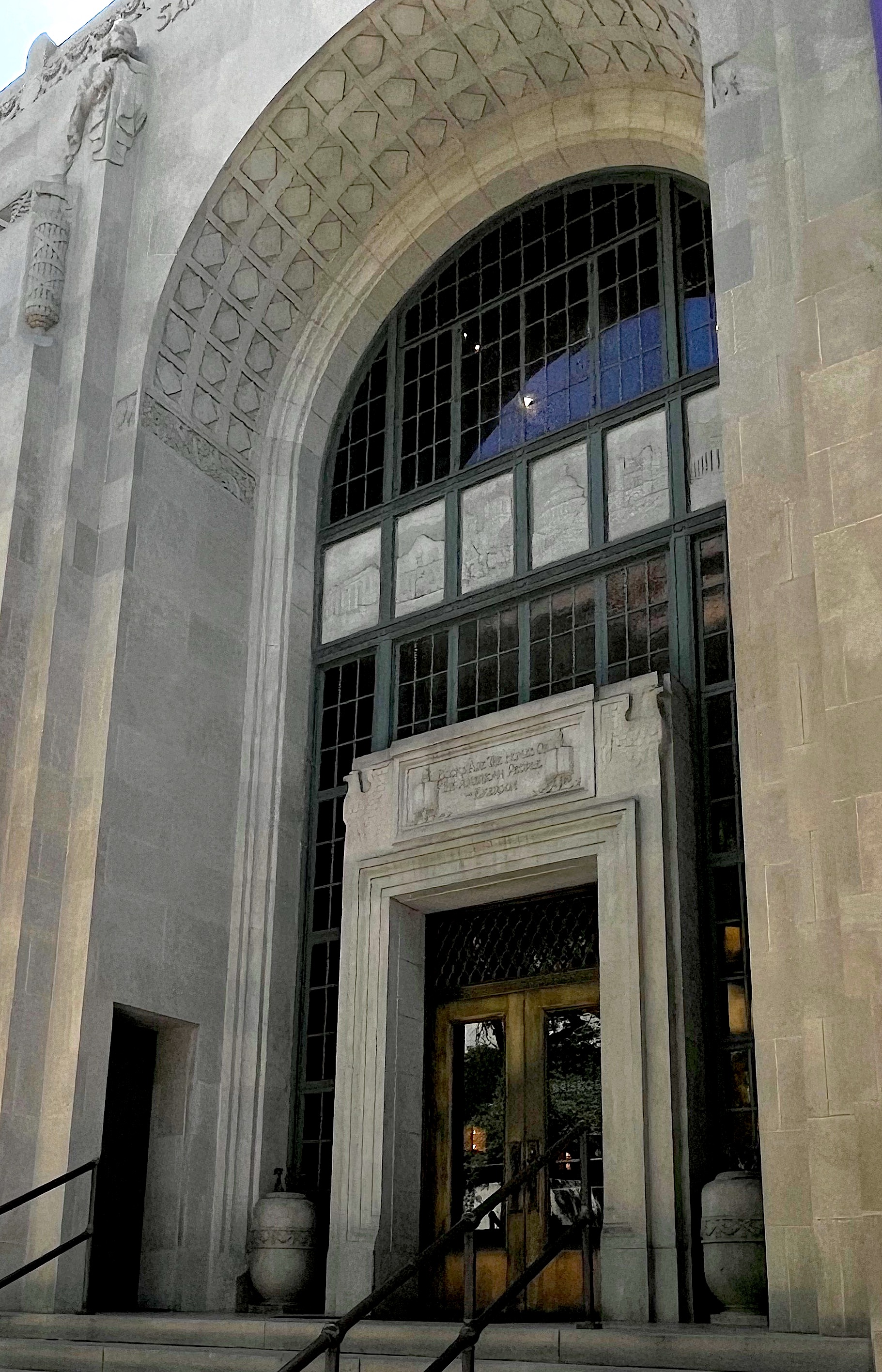
Green conceived of the building in the then-popular art deco style with clean geometric lines. The tall three- story facade was flanked by two single story wings.  Behind this the structure rose to the height of the facade; and contained the heart of the library, its book stacks. To the rear were two lower wings that matched in size those in front, also holding stacks.. The restrained decorations on its exterior echoed the refined purpose of the library with some literary mottoes thought appropriate by white masculine thinkers of the early 20th century. Over the Presa Street entrance surrounded with classical decorative motifs, a quote by the now-forgotten poet William Ellery Channing: "In The Best Books Great Men Talk To Us.  Give Us Their Most Precious Thoughts, And Pour Their Souls Into Ours." On the building's opposite side is one by James A. Garfield: "Next In Importance To Freedom And Justice Is Popular Education, Without Which Neither Freedom Nor Justice Can Be Permanently Maintained."  This one, surmounted by a frieze of a book within a rayed ring flanked by two Bison, seems ironic in the light of present-day book banning by our Texas legislature.


The inscription over the main entrance features the words of Ralph Waldo Emerson between two lions and two opened books: "Books Are The Homes of American People."  This doorway is recessed into a coffered niche that rises nearly the height of the facade, Higher up over the main doorway is a frieze of five venerable buildings which were considered important for for San Antonians: the Parthenon, the Alamo (the completed facade of 1849), Mission Concepción, the U.S. Capitol, the old court of King's College, Cambridge (supposedly the first public library in the world), and the Lincoln Memorial. Finally, flanking the arched portal to either side, near the top of the facade are two busts, to the left, Cervantes and to the right, Shakespeare. These figures represented two of the foremost figures of the European author's canon--Cervantes, perhaps because of the first Hispanic Europeans to settle San Antonio, the Canary Islanders, and Shakespeare for the city's subsequent Anglo-Saxon occupants?


The rest of the exterior decoration was sparing: a frieze of garlands along the upper story, and a couple of footed stands with urns on them on either side of the doorway. On the recessed wall by the Presa Street doorway was a plaque with the Gettysburg Address on it--a survivor of the library's Carnegie predecessor. The exterior was thus a cultured manifestation of the building's noble purpose--indeed the August 3, 1930 issue of the San Antonio Light called it "[An] Elaborate Monument to Literature."

Library Lobby


This dignified decor was continued in the library's impressive two-story lobby--an art-deco-neoclassic fusion. At its top, a gilded plaster ceiling of neoclassic coffering, with a frieze below it containing those buffalo nickel faces.  On three sides, the walls are divided into two decorative stories, the upper painted a dark green, the lower covered by wood paneling with a palmette frieze at its top.  Tying the two levels together are flat green pilasters, with gilded flattened

Library, Catalogues


capitals with geometric marking.  The wood paneled lower portion is divided on its fourth side (facing the entrance) by a wooden-railed balcony which forms a mezzanine; this creates a lower-ceilinged recess under it, which stretches beyond the lobby to the two side entrances.  The mezzanine was reached by a staircase with its risers covered in cowhide.  The staircase continued to a third floor that contained offices.


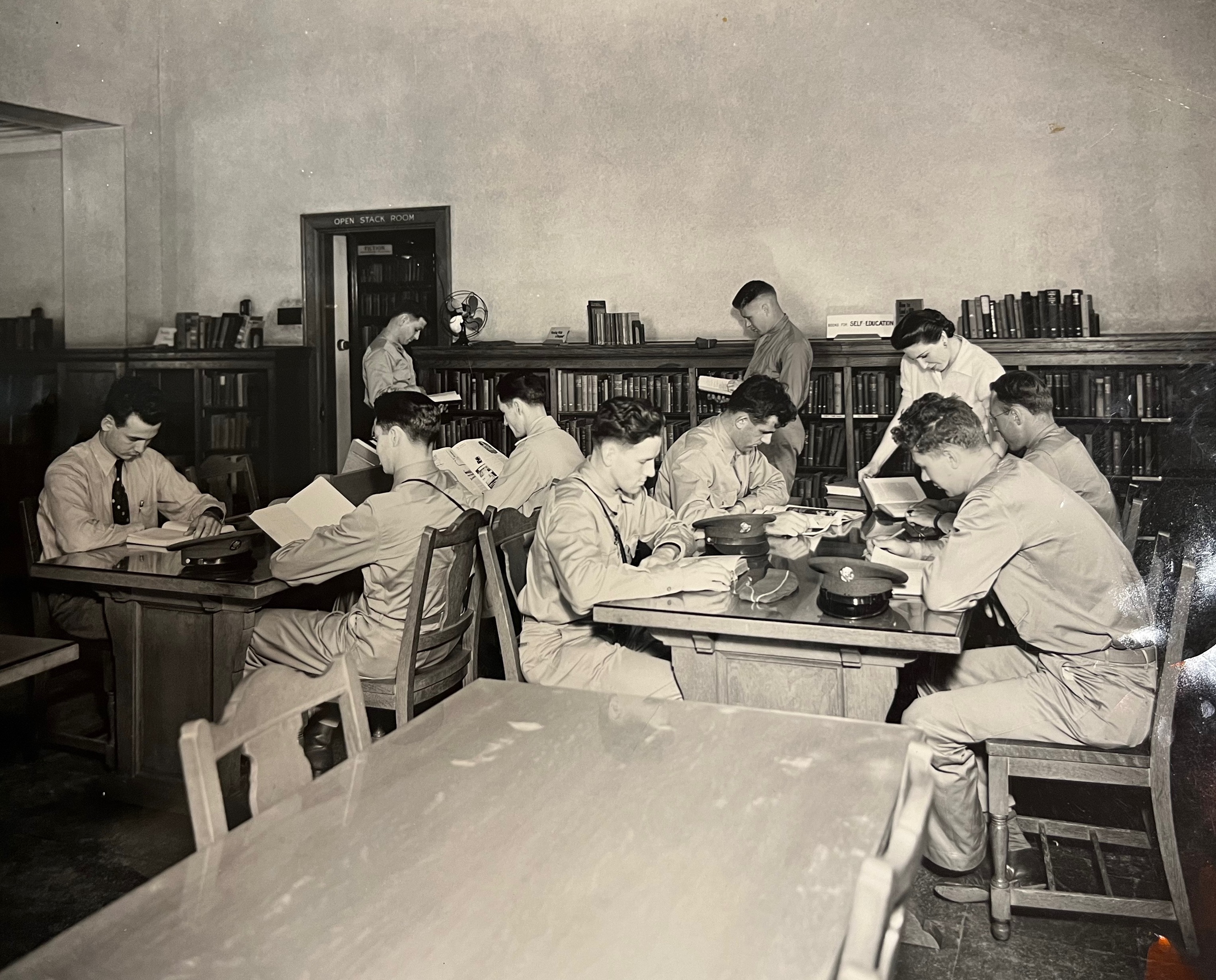
In addition, to the left and the right of the lobby was a reading room to the left and a room dedicated to children on the right (this room's function was later changed and the children's section was relocated to the basement).  The main entry to the library
was flanked by glass windows and pilasters of polished stone.


Library Reading Room
This was what you, in the citizen-borrower part of the building would see and use.  The greater, taller bulk of the building behind this contained six low-ceiling floors of stacks, which housed the
books--the heart of any library.  In 1930, the library operated on a closed stack system: except for some popular books on shelves in the reading room, and a limited access to some first-floor stacks off the same room, prospective readers and borrowers would select their choices from a card catalogue located along the lobby's back wall.  Once submitted, employees called runners would fetch the books from their designated place in the stacks. Everything was classified under a number code called the Dewey Decimal System, as it still is today in public libraries.  Back in the day every book had a corresponding typewritten catalogue card with author, title, and call number.  After the client received the book, they would go to the check-out desk located to the left front of the library.


At some point, the rather dimly lit lobby with its wall sconces and its art deco pendant lighting proved impractical for card catalogue scanning and book checkout space, and so drop fluorescent light fixtures were installed, partially obscuring the original coffered decorations above them. Wall air conditioners were also mounted into the windows flanking the main entrance.

Library with Air Conditioning units and fluorescent  lights


The library proved successful and popular.  Soon satellite branches popped up around the city, but this original building was its hub--until the collection and demand outgrew it in 1967, when it was moved. But just over a decade after its founding, changes were afoot.


____________________________________________________________________________


All black and white photos courtesy of San Antonio Public Library.  The colored one was taken by the author


There are two sources for the history of the site and the initial Carnegie Library: the first is Emily Crawford Wilson's introductory essay for the Briscoe's Catalogue, The West Starts Here, San Antonio, Briscoe Art Museum, 2023, pp.13-33.  The other is "210 W. Market St - A History," a handout published by the San Antonio Public Library Portal, n.d., which can be accessed at: https://guides.mysapl.org/libraryportal/BuildingHistory


For the 1930 library in its original state, see:  "New S.A. Library Opens its Doors to the Public,San Antonio Light,  Aug. 3, 1930, pp.1,22.

                                          The Procession by Paul Moore 


                                                    Part III - A Meditation


Paul Moore is certainly among the greatest sculptors of his generation, not only with collectors and admirers of American Western art, but anywhere, including numerous commissions for portraits of his contemporaries, public monuments, including the colossal Oklahoma Centennial Land Run Monument in Oklahoma City, a 365 foot epic consisting of 45 human figures and numerous horses and wagons--all life sized, to smaller compositions many of which depict scrupulously researched Native Americans of many different tribes.  In addition, he is a Professor of Sculpture at the University of Oklahoma and has passed his craft down to his sons. He is also a prolific collector of objects and artifacts and has a profound knowledge of the history of American sculpture.  There are two full-length interviews, one produced by the National Sculpture Society (2021) and the other (2017) in the Gallery of America series produced by PBS.  A grand selection of his varied works is available to see on his own website Crown Arts, Inc.  I give you links to all three below. So much has been written and videotaped about him and his body of work by so many who know him, that I urge anyone who is interested to seek expert information from the abovementioned sources.


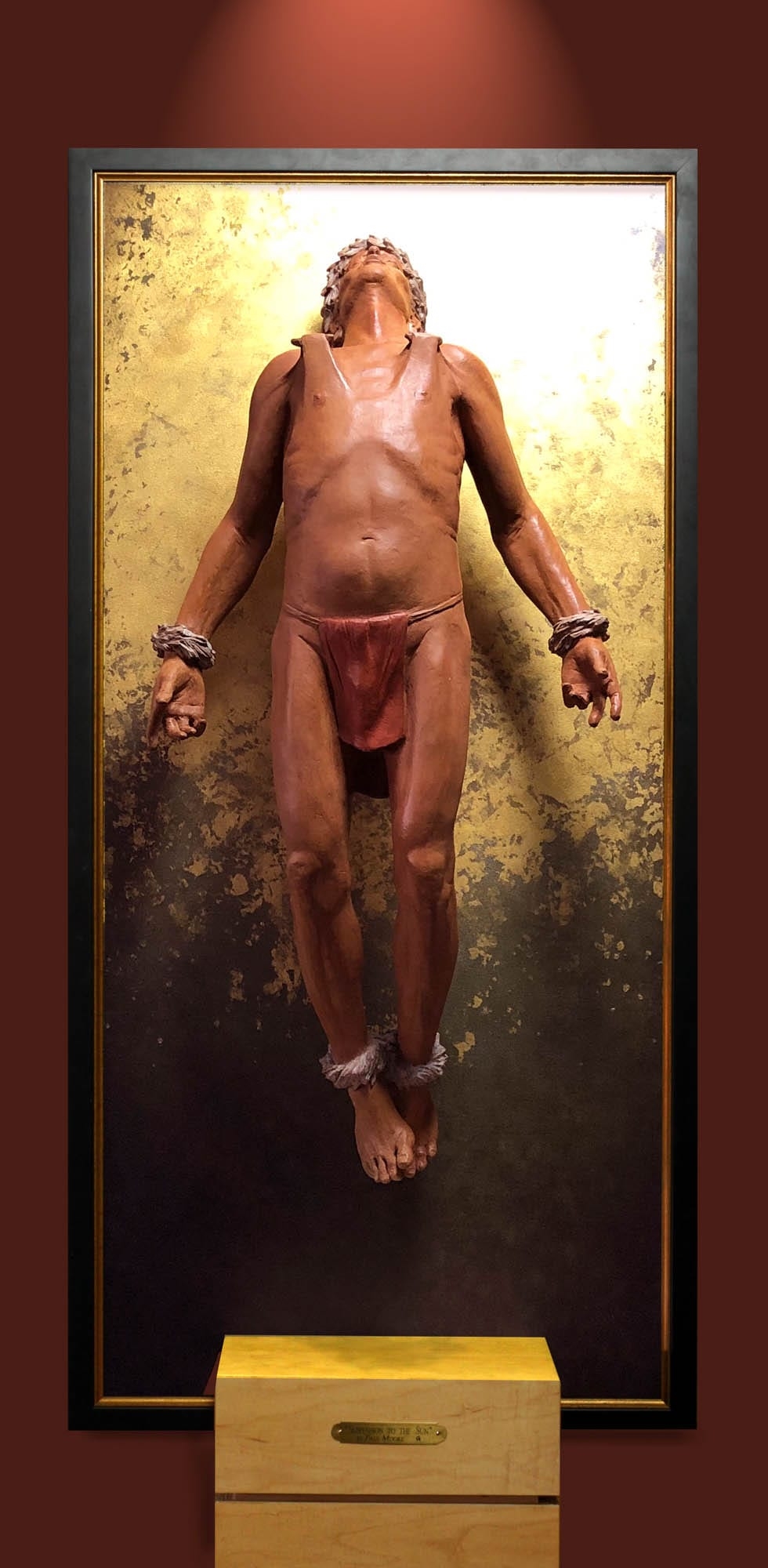
Here, I write only about two small pieces. I have never met Paul Moore, and my only direct experience of his work is The Procession, now in the collection of the Briscoe Museum, which was in the 2020 Night of ArtistsShow and a James Bowie Sculpture prize that year, (this work had also won the prestigious Prix de West the previous year), and another of his works Suspension To The Sun which was featured in the 2021 Night of Artists; I include a photo of it here with some trepidation since I do not know where it is now and who holds the copyright for the reproduction (I hope I will be forgiven).


Paul Moore - Suspension to the Sun

Both these works were done around the same period, during the time of Covid, and are part of a group of mixed media pieces that examine the fusion of Native American with Christian beliefs. Some are like altarpieces, and unlike The Profession, these images are confined to their European Gothic frames (except for a Bison head that rides outwards like a cuckoo clock when its doors are opened). Suspension to the Sunshows a single figure centered in front of a plain rectangular frame.  The figure is suspended above the ground by means of ropes (here invisible) tied to wooden pegs that pierce his shoulder muscles.


The inspiration for this, as Moore explains on his website, is the Mandan ceremony, called the O-Kee-pa, held in spring when young men of the tribe endured an initiation ceremony that lasted four days.  Part of it consisted of the young men having similar piercing of their shoulder and back muscles as well as by darts and suspended from the ceiling of the Mandan Medicine

George Catlin - Okee-pa Ceremony: The Cutting

Lodge by ropes.  This was only the beginning, for the suspension was not to kill, but an ordeal to achieve visions in a state of trance.  They then went through other ordeals.  George Catlin had been present at the ceremony in 1832 and recorded four episodes from it with broad brushstrokes. Catlin's rapidly-painted initiates look slender and ragged, and they are seen from the distance within the lodge.


Moore presents the man, but in a very different way.  The figure is presented frontally, his pierced shoulder muscles looking almost like straps.  His spread-out arms and hand gestures suggest endurance, and also part of his self-offering.  For Catholics, the frontal suspended figure, including the slightly joined feet, may evoke Jesus on the Cross, but his head, tilted backwards to the light, implies an ecstatic experience emphasized by the gold leaf behind him that reflects the studio lighting above it.  The closest thing I can think of is Caravaggio's Conversion of St. Paul, but that light-encompassing figure lies foreshortened away from the

Caravaggio -St. Paul

viewer on the ground, and he's struck blind by his vision. And the heroic nature of Moore's young man with a rope crown, which from the viewer's angle resembles a laurel wreath, tilts towards, and receives the light--an ecstatic vision that climaxes his ordeal. It's a depiction of the crowning moment of a vision quest, part of an age-old and universal initiation. This is a living hero--but all the muscular tension makes it hard to contemplate for long.


This work has a similar spiritual power to The Procession, but the effect on the viewer is different.  I as a viewer can receive a powerful spiritual jolt from Suspension, but its upward-gazing intensity can only inspire the onlooker for a short time, and we can never share it. The wooden block, placed in front of the picture with its label, is also a distancing mechanism. The viewer is not invited to participate in this ritual, but to experience it in their own inner thoughts.   The Procession is just the opposite: it appears to move towards you, soon you will be embraced by its spirituality--drawing you in.


___________________________________________


Paul Moore's Suspension in the Sun can be seen on his website: https://crownartsinc.com/art-gallery/ols/products/xn-suspension-to-the-sun-ol9lnb

Others in this same series can be accessed at the same website; click on the years 2019 and 2020.


George Catlin's Okee-pa scenes (1832) consist of four paintings.  Three are in the Anschutz Western Art Museum, Denver.  The fourth ("The Cutting Scene") is in the Denver Art Museum https://www.denverartmuseum.org/en/edu/object/cutting-scene-mandan-o-kee-pa-ceremony.  These scenes were reissued under Catlin's supervision as lithographs, starting in 1841, and he lectured on them too.  See also George Catlin and His Indian Gallery, Washington, Smithsonian Institution, 2002, pp. 48, 210-215.

                                         The Procession by Paul Moore:  


                                            Part II - Other Assorted Processions


Both composers and visual artists have had their hand in evoking processions in their respective media.  A lot of narrative musical compositions conjure them up as aural narratives, particularly in the late 19th and early 20th centuries.  Since music moves through time, it's easy to conjure up the auditory experience of a passing parade, soft in the distance, getting louder as it passes by, and then diminishing in volume as it moves away--continuity being established by a repeated cadence, so a person could imagine a passing caravan in Alexander Borodin's In the Steppes of Central Asia (1880), or a more dynamic one in Ottorino Respighi's Pines of Rome  (1924) where a ghost army of Roman Legionnaires emerges faintly from shadows along the Appian Way to stop very loudly in front of you.).  Even more relevant to Moore's work is Isaac's Albéniz' El Corpus en Sevilla (1906), for its similar theme and its cadence, though on a far more elaborate and theatrical scale.


To understand how singular Paul Moore's The Procession is in its visual impact and emotional charisma is, it's also worth doing a bit of classical art historical comparisons.  There are many works of visual art that have processions and parades as their principal subject.  The problem here is to show movement through static media. I am restricting my examples to religious processions, which offers examples going as far back as far as we have organized societies and artists to commemorate them.


A famous procession in Egypt, the feast of Opet was celebrated in Luxor from the New Kingdom right up to the introduction of Christianity.  It commemorated the season when the Nile flooded, bringing the time of farming, and was extended to fertility in general.  The parade was the grand finale, when images of the city's greatest gods, Amon-Ra, his wife Mut and their son Khons were ceremoniously carried on boat-like floats from Karnak to Luxor. This journey was depicted in a relief from the Red Temple of Queen Hatshepsut at Karnak, with marchers bearing the boat

Feast of Ophet Temple of Amon-Ra

containing the shrine of Amun-Ra.  Following Egyptian conventions at the time, the shallowly carved representation of marchers, bark and shrine is in a single visual plane, along with accompanying hieroglyphics in the same two-dimensional space.  The bearers are in identical poses, suggesting a cadenced stride of a military cohort.  Movement? Yes, but in two dimensions and not in your own viewing space. It's something you can read rather than taking in in with one glance.


Over many centuries, religious processions were generally shown with the participants moving along a horizontal plane, shown with far more three dimensionality, but always parallel to the onlookers, not intruding into their space. The original, brightly painted frieze of the Parthenon is a nice example: a horseman might twist on his mount, but neither he nor his gaze is directed out of his plane.


Gentile Bellini - Procession in St. Mark's Square

The same can be said of the marchers in Gentile Bellini's Procession in St Mark's Square (Venice, Accademia) : in spite of the deep perspective of the square behind them, the marchers are still seen marching parallel to the picture's viewer, but not deviating from their confined zone.


It's when we get to 19th and early 20th centuries that romantic narratives of religious processions really get going, the painted equivalents of Borodin, Sorolla and Respighi.  But how parades and their progress is conveyed has to be done statically, unless it is things like Chinese hand scrolls, where the time of a journey is sequenced by rolling through it, achieved by only unrolling and then rerolling a portion of it to reveal a moment of progress.


Solomon A. Hart -Simhat Torah at Livorno Synagogue
An example of a narrative of a procession in a single painting is Simchat Torah at Livorno Synagogue by the British-Jewish academician Solomon Alexander Hart in the New York Jewish Museum (1850).  It commemorates the annual celebration of the Torah.  In this scene all of the torah scrolls are being processed through this Italian synagogue by the leading members of the congregation, led by the Rabbi.  As in Moore's sculpture, the marchers of various ages wind from the ark where they are kept, behind the reader and some singers on the elevated bimah or
reading platform.  They are draped in prayer shawls as they carry the scrolls, covered richly colored cases and polished silver staves or crowns.  Unlike Moore, the action stays within the setting, and appears to be passing towards the right, where an elderly congregant walks to meet them so that he can touch the scrolls with his own shawl.  Other male figures, to the left and right, watch the scene in reverence. Maybe Livornese Jewish males dressed in such oriental robes for festivals back then.  Hart had visited the old synagogue in Livorno and this is an accurate recording of the building.  It is beautiful and sumptuous, but presumed spectators in front of the canvas are viewers only to a passing spectacle; they are not invited to participate. 


Ilya Repin Religious Procession in the Kursk Governate

Marchers and witnesses alike in Ilya Repin's Religious Procession in the Kursk Governate (1880-1883) (Tretyakov Museum) are also a passing spectacle, but on a much grander and more chaotic scale. A lot has been written about this painting and its societal commentary, and I give you references to the best of these analyses available online below.  The main point here is that like Hart's painting, the vast procession and its spectators are all conceived on a diagonal that passes to the right of the viewer, but not into his or her space and part of its purpose is to focus on varying individuals and the diverse roles they play.  The viewer is emphatically not a participant in the event nor is invited to be.


Closest in the shared tradition of Catholic holy religious processions to Moore's work is Joaquín Sorolla's Los Nazarinos (1914) showing a Holy Week Procession (which is close to Albéniz' musical procession too).  A group of hooded figures parade with a crucifix and a paso image of  the Virgin under a canopy, down an urban street in Seville--identified as so by the iconic tower of the city's cathedral in the background.  It has been observed, though, that there is no street in the city that offers this particular view of the tower; the black caparotes of the marchers, and the image of the Virgin are not specific to a particular confraternity or church. Though processing generally forwards, the figures are directed slightly to the left, as is the gaze of the left hooded

Joaquin Sorolla -Los Nazarenos

foreground figure, and the crowd of spectators hems the marchers in.  And there is a further difference: the Nazarinos painting is part of a large series of murals commissioned by Archer Huntington for the Hispanic Society in New York and carried out by Sorolla between 1911 and 1919.  The Nazarinos are located in a corner, with a much larger painting of bulls being wrangled to transportation at its left (El Encierro)at its left, and a painting of Toreros in Seville's bullfight to its right, and is therefore an incident within a much larger entity depicting various regions of Spain and their typical activities.


It can be said that the church in Moore's Procession is generic too.  He did small works of acrylic paint and gold leaf of various southwest mission facades, but the isolated one in The Procession appears more generic.  And none of these painted or sculpted comparisons discussed above have the same jolt of movement outwards, and the almost magic realism of the procession leader, at once someone identifiable and yet Everyman. Coming at you.


______________________________________________________________________________

Recordings of Borodin's Steppes exist in several versions in YouTube, for example https://www.youtube.com/watch?v=g4tlQxaHetI.  Those Legionnaires really march in a  remastered recording of Fritz Reiner: https://www.youtube.com/watch?v=Z9El5Hzh3jM, while Gustavo Díaz-Jerez rendition of Corpus is https://www.youtube.com/watch?v=8_55-4CpCro.  But there are many versions of each piece to choose from online. Have fun and close your eyes!


Feast of Opet relief shown is from the Red Temple of Opet.  https://www.nationalgeographic.com/history/history-magazine/article/ancient-egypt-royal-feast


An Explanation of the Parthenon frieze and its participants by Paulina Wegrzyn can be found at "The Parthenon Friezes: Their Story Explained" TheCollector.com, August 2, 2020, https://www.thecollector.com/parthenon-frieze/.


For Bellini's painting, see https://en.wikipedia.org/wiki/Procession_in_St._Mark%27s_Square


Chinese hand scrolls: https://www.metmuseum.org/toah/hd/chhs/hd_chhs.htm


Old photos of Livorno's synagogue before its destruction can be seen at https://livornodailyphoto.blogspot.com/2012/08/the-old-synagogue.html


For two of the best accessible analysis of Repin's monumental work, see the article by Ben Pollit for the Kahn Academy at https://www.khanacademy.org/humanities/becoming-modern/x4910f52e:eastern-europe-1800-1900/wanderers/a/ilya-repin-krestny-khod-religious-procession-in-kursk-gubernia

 And also the analysis by David, the author of a blog on Russian icons at  https://russianicons.wordpress.com/tag/ilya-repin/


On Sorolla see Wikipedia for information and a complete list of the Visions of Spain

paintings: https://en.wikipedia.org/wiki/Vision_of_Spain

A specific discussion of Sorolla's Nazarinos, its context and meaning is available at:

Dr. César Lopez Gomez- Joaquin Sorolla "Los Nazarenos," 1914. Nueva York, Hispanic Society of America -- https://cesarlopezgomez.com/joaquin-sorolla-los-nazarenos-1914-nueva-york-hispanic-society-of-america/


                                            The Procession by Paul Moore


I've written about this work for the Briscoe Museum catalogue, but it continues to move me every time I see it.  I wanted think and write more about it, so here goes (this will be a 3- parter)


                                               Part I - The Work itself


A religious procession winds towards us, apparently coming from the adobe church off to the right, its earthy color the same as the landscape around it.  Leading it is a middle-aged man, very much a portrait-like person with individualized features right down to his receding hairline and grayish braids, holding a processional crucifix of what appears to be polychromed wood.  Behind him is an orderly file of participants, those closest to him carrying an image of the Virgin Mary, her face in shadow under a makeshift canopy of what appears to be wood and canvas.  Everyone but the leader and one man to the left holding a sombrero, is dressed in blankets or shawls of browns and whites, draped over their hair as well as their bodies, muffling their faces so that their genders are unclear, and in many cases their facial features too. Most are of similar height, except for one child near the church.


Aside from white in the blankets and shoes and some clouds to the left rear, the only other color beyond shades of brown allowed is a light blue in the shirt of the procession leader, the cloak of the image of the Virgin and a strip of sky. Silver is also present on the halo of Christ on the processional cross, and the smaller crucifix carried the by marcher to the viewer's right of the leader.


The barrenness of the landscape with its few scattered shrubs (sagebrush?), the adobe church which seems part of the earth and rising from it, the generic features of the marchers and their blanket-mantles emerging, it seems, from behind the church, suggests the pueblo culture of New Mexico and Arizona, and the isolated location of the building out in the desert is deliberately non-specific.


The work is primarily bronze casting including its gilded "frame" and the reclining "ornamental" figures at the top, except for the pale green wooden table on which the framed scene rests, but this too is part of the sculpture, so I guess it's really mixed media. Several features make it wonderfully deceptive. In the composition proper, the relief ranges from low to completely in the round for the leader, his crucifix, and the two figures behind him.  But the church towers also project beyond the "frame," and the canopy over the Virgin image casts a shadow.  The ground slopes outwards so that the foreground figures literally enter the viewer's space, and the bottom of the frame is no longer an ornamental boundary as the sloping ground continues outwards.  


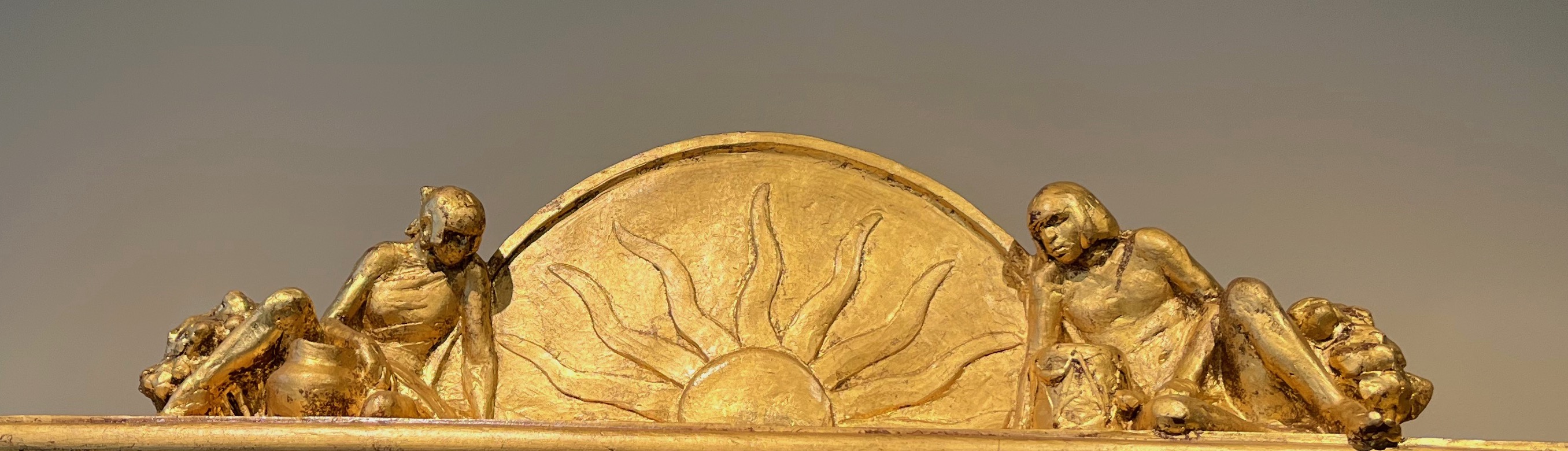
The varying levels of relief and projecting figures and plants also cast real shadows, which ca vary with the way the work is lit, though the patinated shadow cast by a crucifix that appears at an angle behind the leader and over the carriers of the image of the Virgin, made of brownish and blackish tones seems to suggest a different cross altogether--but where is it?. The gilded frame itself with its classical brackets and dentils, as well as the reclining figures on top, evoke a traditional Renaissance-Baroque altar, but the two figures have features and hairstyles of native Americans, as does the pot by the one to the left.  


Traditional Christian altarpieces in the semicircle they flank would have the space there occupied by a Christian icon (Trinity, God the Father, etc.) but here it is a rayed sun. The only additional Christian symbol is the roughly painted red Sacred Heart painted on the real but worn-appearing wooden table below--all of this constructed and decorated too by Moore himself.


The bronze composition achieves its earthily multicolored effects by the application of subtly colored patinas. and by making the areas beyond the central plaque of the composition and the "frame" neutral, further enhances the aura of processional theater.


If a person stands far enough away from the sculpture (in the Briscoe Museum this is possible), they could almost believe that the figures are human, and that they are coming from the church or from behind it, and really moving slowly, stepping into your space and will soon reach you, and then they will be life-sized.


Paul Moore's artist's statement about this work pretty much sums it up:


            "The Procession" was made to honor the religious aspect of the various Pueblos where     90% of the Pueblo people are Catholic with a blending of their ancient culture intertwined with Christianity. Throughout the year various processions are performed to   honor Jesus Christ, the Virgin Mary and the lives of various Saints. I created this piece to look like an alter is coming to life and walking out from the bonds of the frame like the believers do in taking their faith to the masses.


To this writer, the key to this profoundly emotional work is the figure of the leader with his individualized facial features and his dignified demeanor.  He is both conscious of his role but also totally absorbed in his own spiritual experience as he turns his head slightly to the right, though he walks straight on.  As he appears to walk forward, the position of his feet and his posture suggest the slow dignified cadence of the procession he leads and how he defines this


rhythm.  The people he leads coalesce behind him into a complete spiritual entity.  Not only does the terrain physically sloping outwards help suggest this (the foreground plants project too), but the artist manipulates the perspective of the figures behind him and the foreshortening of the church and combines this with actual shadows cast by those elements in highest relief and full three dimensionality. It's hard to determine where two dimensionality becomes three.


From an art historian's point of view, Moore combines the literally rendered with suggestive abstraction, and blurs the line between art and life; when you look at the desert setting and it multiple dimensions, the flat area behind the composition proper and the projecting elements of the frame suddenly pulls the viewers up short to remind them it's just a bronze plaque.


He also subtly combines some artistic conventions of a framed altarpiece in Catholic, European based tradition, and then changes and modifies this tradition both by the reclining figures and sun symbol of indigenous belief, and the deconstruction of the frame at the bottom, which then is seen to be resting on a rough, aging table, reminding us that the whole bronze composition above really is just an altarpiece.


            But is it?

            (to be continued).


____________________________________________________________________________

Paul Moore's Artist Statement can be found at: https://crownartsinc.com/art-gallery/ols/products/the-procession


Carmen Tafolla, San Antonio's Poet Laureate of 2015, penned a piece of ekphrastic poetry in response to Moore's piece.  You can watch and hear her reading it aloud in the Briscoe's sculpture garden at: https://www.facebook.com/watch/?v=1136575313578044

William Herbert Dunton (otherwise known as Buck), Illustrator

  William Herbert Dunton (otherwise known as Buck), Illustrator     William H. Dunton: Vaquero (1909); Briscoe Museum                   He s...