The Procession by Paul Moore 


                                                    Part III - A Meditation


Paul Moore is certainly among the greatest sculptors of his generation, not only with collectors and admirers of American Western art, but anywhere, including numerous commissions for portraits of his contemporaries, public monuments, including the colossal Oklahoma Centennial Land Run Monument in Oklahoma City, a 365 foot epic consisting of 45 human figures and numerous horses and wagons--all life sized, to smaller compositions many of which depict scrupulously researched Native Americans of many different tribes.  In addition, he is a Professor of Sculpture at the University of Oklahoma and has passed his craft down to his sons. He is also a prolific collector of objects and artifacts and has a profound knowledge of the history of American sculpture.  There are two full-length interviews, one produced by the National Sculpture Society (2021) and the other (2017) in the Gallery of America series produced by PBS.  A grand selection of his varied works is available to see on his own website Crown Arts, Inc.  I give you links to all three below. So much has been written and videotaped about him and his body of work by so many who know him, that I urge anyone who is interested to seek expert information from the abovementioned sources.


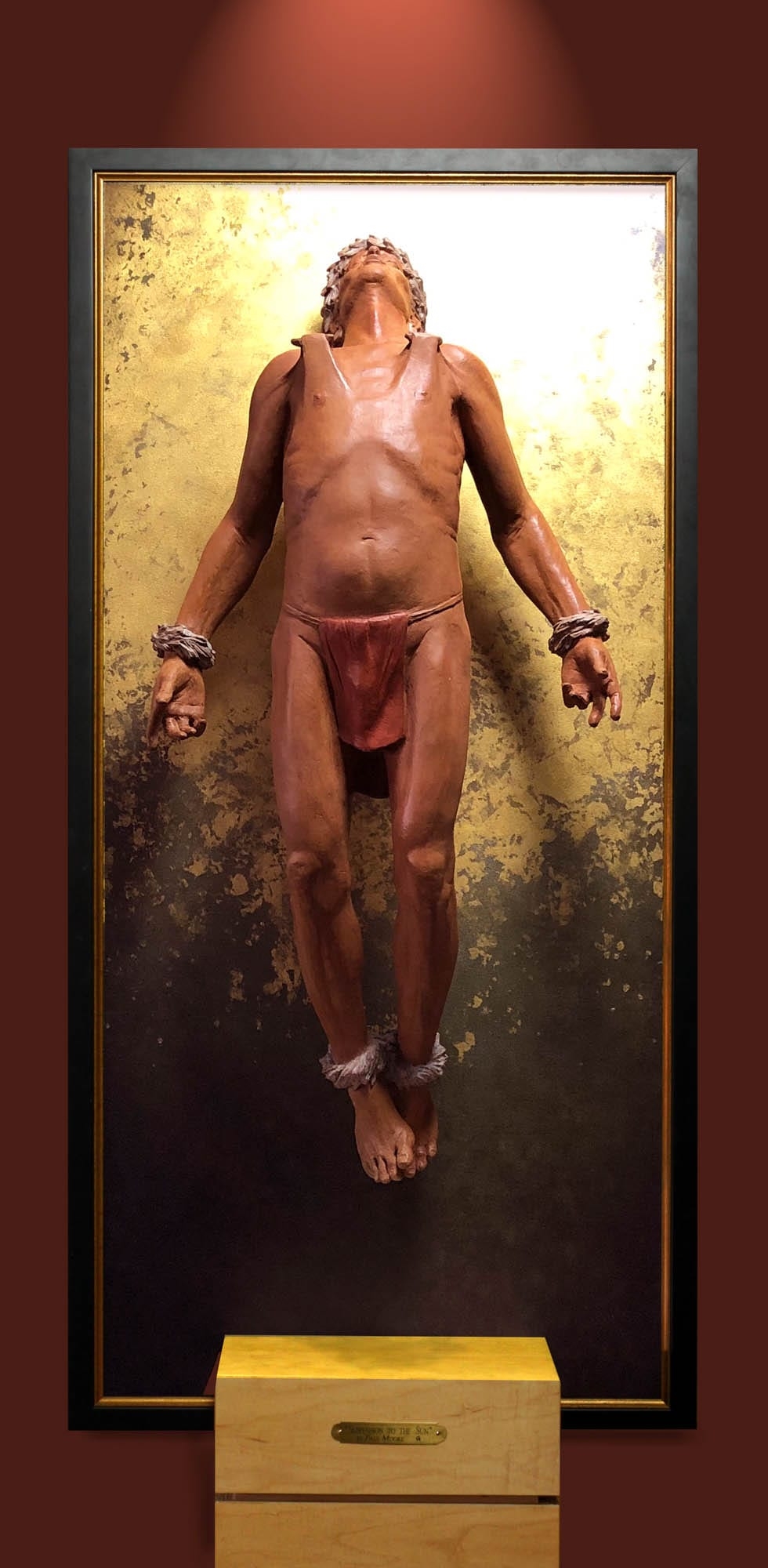
Here, I write only about two small pieces. I have never met Paul Moore, and my only direct experience of his work is The Procession, now in the collection of the Briscoe Museum, which was in the 2020 Night of ArtistsShow and a James Bowie Sculpture prize that year, (this work had also won the prestigious Prix de West the previous year), and another of his works Suspension To The Sun which was featured in the 2021 Night of Artists; I include a photo of it here with some trepidation since I do not know where it is now and who holds the copyright for the reproduction (I hope I will be forgiven).


Paul Moore - Suspension to the Sun

Both these works were done around the same period, during the time of Covid, and are part of a group of mixed media pieces that examine the fusion of Native American with Christian beliefs. Some are like altarpieces, and unlike The Profession, these images are confined to their European Gothic frames (except for a Bison head that rides outwards like a cuckoo clock when its doors are opened). Suspension to the Sunshows a single figure centered in front of a plain rectangular frame.  The figure is suspended above the ground by means of ropes (here invisible) tied to wooden pegs that pierce his shoulder muscles.


The inspiration for this, as Moore explains on his website, is the Mandan ceremony, called the O-Kee-pa, held in spring when young men of the tribe endured an initiation ceremony that lasted four days.  Part of it consisted of the young men having similar piercing of their shoulder and back muscles as well as by darts and suspended from the ceiling of the Mandan Medicine

George Catlin - Okee-pa Ceremony: The Cutting

Lodge by ropes.  This was only the beginning, for the suspension was not to kill, but an ordeal to achieve visions in a state of trance.  They then went through other ordeals.  George Catlin had been present at the ceremony in 1832 and recorded four episodes from it with broad brushstrokes. Catlin's rapidly-painted initiates look slender and ragged, and they are seen from the distance within the lodge.


Moore presents the man, but in a very different way.  The figure is presented frontally, his pierced shoulder muscles looking almost like straps.  His spread-out arms and hand gestures suggest endurance, and also part of his self-offering.  For Catholics, the frontal suspended figure, including the slightly joined feet, may evoke Jesus on the Cross, but his head, tilted backwards to the light, implies an ecstatic experience emphasized by the gold leaf behind him that reflects the studio lighting above it.  The closest thing I can think of is Caravaggio's Conversion of St. Paul, but that light-encompassing figure lies foreshortened away from the

Caravaggio -St. Paul

viewer on the ground, and he's struck blind by his vision. And the heroic nature of Moore's young man with a rope crown, which from the viewer's angle resembles a laurel wreath, tilts towards, and receives the light--an ecstatic vision that climaxes his ordeal. It's a depiction of the crowning moment of a vision quest, part of an age-old and universal initiation. This is a living hero--but all the muscular tension makes it hard to contemplate for long.


This work has a similar spiritual power to The Procession, but the effect on the viewer is different.  I as a viewer can receive a powerful spiritual jolt from Suspension, but its upward-gazing intensity can only inspire the onlooker for a short time, and we can never share it. The wooden block, placed in front of the picture with its label, is also a distancing mechanism. The viewer is not invited to participate in this ritual, but to experience it in their own inner thoughts.   The Procession is just the opposite: it appears to move towards you, soon you will be embraced by its spirituality--drawing you in.


___________________________________________


Paul Moore's Suspension in the Sun can be seen on his website: https://crownartsinc.com/art-gallery/ols/products/xn-suspension-to-the-sun-ol9lnb

Others in this same series can be accessed at the same website; click on the years 2019 and 2020.


George Catlin's Okee-pa scenes (1832) consist of four paintings.  Three are in the Anschutz Western Art Museum, Denver.  The fourth ("The Cutting Scene") is in the Denver Art Museum https://www.denverartmuseum.org/en/edu/object/cutting-scene-mandan-o-kee-pa-ceremony.  These scenes were reissued under Catlin's supervision as lithographs, starting in 1841, and he lectured on them too.  See also George Catlin and His Indian Gallery, Washington, Smithsonian Institution, 2002, pp. 48, 210-215.

                                         The Procession by Paul Moore:  


                                            Part II - Other Assorted Processions


Both composers and visual artists have had their hand in evoking processions in their respective media.  A lot of narrative musical compositions conjure them up as aural narratives, particularly in the late 19th and early 20th centuries.  Since music moves through time, it's easy to conjure up the auditory experience of a passing parade, soft in the distance, getting louder as it passes by, and then diminishing in volume as it moves away--continuity being established by a repeated cadence, so a person could imagine a passing caravan in Alexander Borodin's In the Steppes of Central Asia (1880), or a more dynamic one in Ottorino Respighi's Pines of Rome  (1924) where a ghost army of Roman Legionnaires emerges faintly from shadows along the Appian Way to stop very loudly in front of you.).  Even more relevant to Moore's work is Isaac's Albéniz' El Corpus en Sevilla (1906), for its similar theme and its cadence, though on a far more elaborate and theatrical scale.


To understand how singular Paul Moore's The Procession is in its visual impact and emotional charisma is, it's also worth doing a bit of classical art historical comparisons.  There are many works of visual art that have processions and parades as their principal subject.  The problem here is to show movement through static media. I am restricting my examples to religious processions, which offers examples going as far back as far as we have organized societies and artists to commemorate them.


A famous procession in Egypt, the feast of Opet was celebrated in Luxor from the New Kingdom right up to the introduction of Christianity.  It commemorated the season when the Nile flooded, bringing the time of farming, and was extended to fertility in general.  The parade was the grand finale, when images of the city's greatest gods, Amon-Ra, his wife Mut and their son Khons were ceremoniously carried on boat-like floats from Karnak to Luxor. This journey was depicted in a relief from the Red Temple of Queen Hatshepsut at Karnak, with marchers bearing the boat

Feast of Ophet Temple of Amon-Ra

containing the shrine of Amun-Ra.  Following Egyptian conventions at the time, the shallowly carved representation of marchers, bark and shrine is in a single visual plane, along with accompanying hieroglyphics in the same two-dimensional space.  The bearers are in identical poses, suggesting a cadenced stride of a military cohort.  Movement? Yes, but in two dimensions and not in your own viewing space. It's something you can read rather than taking in in with one glance.


Over many centuries, religious processions were generally shown with the participants moving along a horizontal plane, shown with far more three dimensionality, but always parallel to the onlookers, not intruding into their space. The original, brightly painted frieze of the Parthenon is a nice example: a horseman might twist on his mount, but neither he nor his gaze is directed out of his plane.


Gentile Bellini - Procession in St. Mark's Square

The same can be said of the marchers in Gentile Bellini's Procession in St Mark's Square (Venice, Accademia) : in spite of the deep perspective of the square behind them, the marchers are still seen marching parallel to the picture's viewer, but not deviating from their confined zone.


It's when we get to 19th and early 20th centuries that romantic narratives of religious processions really get going, the painted equivalents of Borodin, Sorolla and Respighi.  But how parades and their progress is conveyed has to be done statically, unless it is things like Chinese hand scrolls, where the time of a journey is sequenced by rolling through it, achieved by only unrolling and then rerolling a portion of it to reveal a moment of progress.


Solomon A. Hart -Simhat Torah at Livorno Synagogue
An example of a narrative of a procession in a single painting is Simchat Torah at Livorno Synagogue by the British-Jewish academician Solomon Alexander Hart in the New York Jewish Museum (1850).  It commemorates the annual celebration of the Torah.  In this scene all of the torah scrolls are being processed through this Italian synagogue by the leading members of the congregation, led by the Rabbi.  As in Moore's sculpture, the marchers of various ages wind from the ark where they are kept, behind the reader and some singers on the elevated bimah or
reading platform.  They are draped in prayer shawls as they carry the scrolls, covered richly colored cases and polished silver staves or crowns.  Unlike Moore, the action stays within the setting, and appears to be passing towards the right, where an elderly congregant walks to meet them so that he can touch the scrolls with his own shawl.  Other male figures, to the left and right, watch the scene in reverence. Maybe Livornese Jewish males dressed in such oriental robes for festivals back then.  Hart had visited the old synagogue in Livorno and this is an accurate recording of the building.  It is beautiful and sumptuous, but presumed spectators in front of the canvas are viewers only to a passing spectacle; they are not invited to participate. 


Ilya Repin Religious Procession in the Kursk Governate

Marchers and witnesses alike in Ilya Repin's Religious Procession in the Kursk Governate (1880-1883) (Tretyakov Museum) are also a passing spectacle, but on a much grander and more chaotic scale. A lot has been written about this painting and its societal commentary, and I give you references to the best of these analyses available online below.  The main point here is that like Hart's painting, the vast procession and its spectators are all conceived on a diagonal that passes to the right of the viewer, but not into his or her space and part of its purpose is to focus on varying individuals and the diverse roles they play.  The viewer is emphatically not a participant in the event nor is invited to be.


Closest in the shared tradition of Catholic holy religious processions to Moore's work is Joaquín Sorolla's Los Nazarinos (1914) showing a Holy Week Procession (which is close to Albéniz' musical procession too).  A group of hooded figures parade with a crucifix and a paso image of  the Virgin under a canopy, down an urban street in Seville--identified as so by the iconic tower of the city's cathedral in the background.  It has been observed, though, that there is no street in the city that offers this particular view of the tower; the black caparotes of the marchers, and the image of the Virgin are not specific to a particular confraternity or church. Though processing generally forwards, the figures are directed slightly to the left, as is the gaze of the left hooded

Joaquin Sorolla -Los Nazarenos

foreground figure, and the crowd of spectators hems the marchers in.  And there is a further difference: the Nazarinos painting is part of a large series of murals commissioned by Archer Huntington for the Hispanic Society in New York and carried out by Sorolla between 1911 and 1919.  The Nazarinos are located in a corner, with a much larger painting of bulls being wrangled to transportation at its left (El Encierro)at its left, and a painting of Toreros in Seville's bullfight to its right, and is therefore an incident within a much larger entity depicting various regions of Spain and their typical activities.


It can be said that the church in Moore's Procession is generic too.  He did small works of acrylic paint and gold leaf of various southwest mission facades, but the isolated one in The Procession appears more generic.  And none of these painted or sculpted comparisons discussed above have the same jolt of movement outwards, and the almost magic realism of the procession leader, at once someone identifiable and yet Everyman. Coming at you.


______________________________________________________________________________

Recordings of Borodin's Steppes exist in several versions in YouTube, for example https://www.youtube.com/watch?v=g4tlQxaHetI.  Those Legionnaires really march in a  remastered recording of Fritz Reiner: https://www.youtube.com/watch?v=Z9El5Hzh3jM, while Gustavo Díaz-Jerez rendition of Corpus is https://www.youtube.com/watch?v=8_55-4CpCro.  But there are many versions of each piece to choose from online. Have fun and close your eyes!


Feast of Opet relief shown is from the Red Temple of Opet.  https://www.nationalgeographic.com/history/history-magazine/article/ancient-egypt-royal-feast


An Explanation of the Parthenon frieze and its participants by Paulina Wegrzyn can be found at "The Parthenon Friezes: Their Story Explained" TheCollector.com, August 2, 2020, https://www.thecollector.com/parthenon-frieze/.


For Bellini's painting, see https://en.wikipedia.org/wiki/Procession_in_St._Mark%27s_Square


Chinese hand scrolls: https://www.metmuseum.org/toah/hd/chhs/hd_chhs.htm


Old photos of Livorno's synagogue before its destruction can be seen at https://livornodailyphoto.blogspot.com/2012/08/the-old-synagogue.html


For two of the best accessible analysis of Repin's monumental work, see the article by Ben Pollit for the Kahn Academy at https://www.khanacademy.org/humanities/becoming-modern/x4910f52e:eastern-europe-1800-1900/wanderers/a/ilya-repin-krestny-khod-religious-procession-in-kursk-gubernia

 And also the analysis by David, the author of a blog on Russian icons at  https://russianicons.wordpress.com/tag/ilya-repin/


On Sorolla see Wikipedia for information and a complete list of the Visions of Spain

paintings: https://en.wikipedia.org/wiki/Vision_of_Spain

A specific discussion of Sorolla's Nazarinos, its context and meaning is available at:

Dr. César Lopez Gomez- Joaquin Sorolla "Los Nazarenos," 1914. Nueva York, Hispanic Society of America -- https://cesarlopezgomez.com/joaquin-sorolla-los-nazarenos-1914-nueva-york-hispanic-society-of-america/


                                            The Procession by Paul Moore


I've written about this work for the Briscoe Museum catalogue, but it continues to move me every time I see it.  I wanted think and write more about it, so here goes (this will be a 3- parter)


                                               Part I - The Work itself


A religious procession winds towards us, apparently coming from the adobe church off to the right, its earthy color the same as the landscape around it.  Leading it is a middle-aged man, very much a portrait-like person with individualized features right down to his receding hairline and grayish braids, holding a processional crucifix of what appears to be polychromed wood.  Behind him is an orderly file of participants, those closest to him carrying an image of the Virgin Mary, her face in shadow under a makeshift canopy of what appears to be wood and canvas.  Everyone but the leader and one man to the left holding a sombrero, is dressed in blankets or shawls of browns and whites, draped over their hair as well as their bodies, muffling their faces so that their genders are unclear, and in many cases their facial features too. Most are of similar height, except for one child near the church.


Aside from white in the blankets and shoes and some clouds to the left rear, the only other color beyond shades of brown allowed is a light blue in the shirt of the procession leader, the cloak of the image of the Virgin and a strip of sky. Silver is also present on the halo of Christ on the processional cross, and the smaller crucifix carried the by marcher to the viewer's right of the leader.


The barrenness of the landscape with its few scattered shrubs (sagebrush?), the adobe church which seems part of the earth and rising from it, the generic features of the marchers and their blanket-mantles emerging, it seems, from behind the church, suggests the pueblo culture of New Mexico and Arizona, and the isolated location of the building out in the desert is deliberately non-specific.


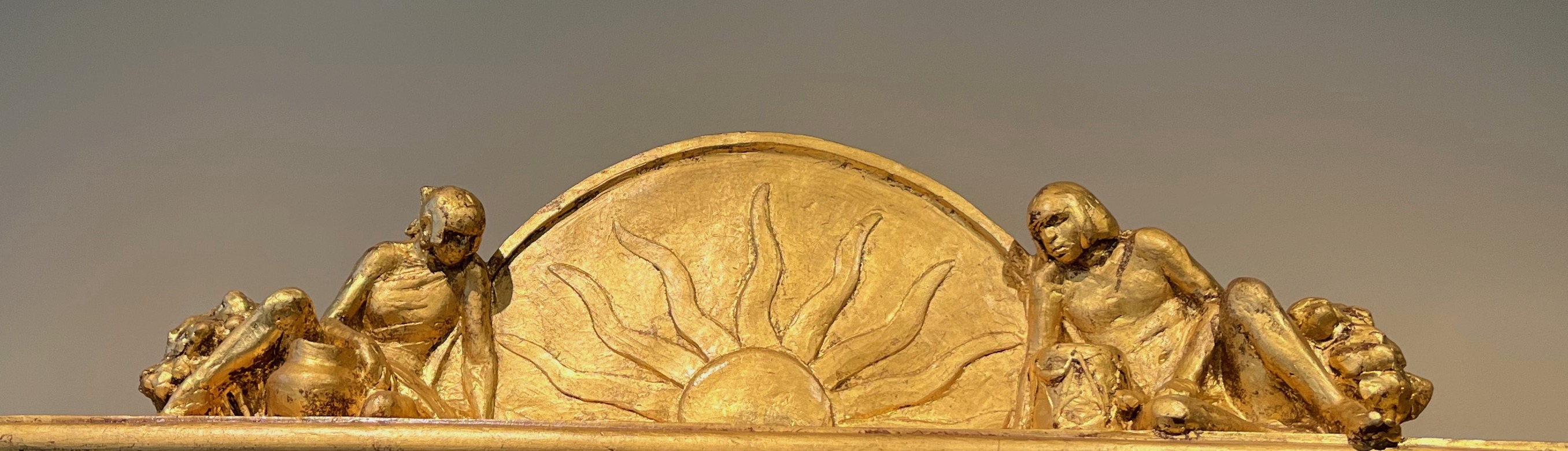
The work is primarily bronze casting including its gilded "frame" and the reclining "ornamental" figures at the top, except for the pale green wooden table on which the framed scene rests, but this too is part of the sculpture, so I guess it's really mixed media. Several features make it wonderfully deceptive. In the composition proper, the relief ranges from low to completely in the round for the leader, his crucifix, and the two figures behind him.  But the church towers also project beyond the "frame," and the canopy over the Virgin image casts a shadow.  The ground slopes outwards so that the foreground figures literally enter the viewer's space, and the bottom of the frame is no longer an ornamental boundary as the sloping ground continues outwards.  


The varying levels of relief and projecting figures and plants also cast real shadows, which ca vary with the way the work is lit, though the patinated shadow cast by a crucifix that appears at an angle behind the leader and over the carriers of the image of the Virgin, made of brownish and blackish tones seems to suggest a different cross altogether--but where is it?. The gilded frame itself with its classical brackets and dentils, as well as the reclining figures on top, evoke a traditional Renaissance-Baroque altar, but the two figures have features and hairstyles of native Americans, as does the pot by the one to the left.  


Traditional Christian altarpieces in the semicircle they flank would have the space there occupied by a Christian icon (Trinity, God the Father, etc.) but here it is a rayed sun. The only additional Christian symbol is the roughly painted red Sacred Heart painted on the real but worn-appearing wooden table below--all of this constructed and decorated too by Moore himself.


The bronze composition achieves its earthily multicolored effects by the application of subtly colored patinas. and by making the areas beyond the central plaque of the composition and the "frame" neutral, further enhances the aura of processional theater.


If a person stands far enough away from the sculpture (in the Briscoe Museum this is possible), they could almost believe that the figures are human, and that they are coming from the church or from behind it, and really moving slowly, stepping into your space and will soon reach you, and then they will be life-sized.


Paul Moore's artist's statement about this work pretty much sums it up:


            "The Procession" was made to honor the religious aspect of the various Pueblos where     90% of the Pueblo people are Catholic with a blending of their ancient culture intertwined with Christianity. Throughout the year various processions are performed to   honor Jesus Christ, the Virgin Mary and the lives of various Saints. I created this piece to look like an alter is coming to life and walking out from the bonds of the frame like the believers do in taking their faith to the masses.


To this writer, the key to this profoundly emotional work is the figure of the leader with his individualized facial features and his dignified demeanor.  He is both conscious of his role but also totally absorbed in his own spiritual experience as he turns his head slightly to the right, though he walks straight on.  As he appears to walk forward, the position of his feet and his posture suggest the slow dignified cadence of the procession he leads and how he defines this


rhythm.  The people he leads coalesce behind him into a complete spiritual entity.  Not only does the terrain physically sloping outwards help suggest this (the foreground plants project too), but the artist manipulates the perspective of the figures behind him and the foreshortening of the church and combines this with actual shadows cast by those elements in highest relief and full three dimensionality. It's hard to determine where two dimensionality becomes three.


From an art historian's point of view, Moore combines the literally rendered with suggestive abstraction, and blurs the line between art and life; when you look at the desert setting and it multiple dimensions, the flat area behind the composition proper and the projecting elements of the frame suddenly pulls the viewers up short to remind them it's just a bronze plaque.


He also subtly combines some artistic conventions of a framed altarpiece in Catholic, European based tradition, and then changes and modifies this tradition both by the reclining figures and sun symbol of indigenous belief, and the deconstruction of the frame at the bottom, which then is seen to be resting on a rough, aging table, reminding us that the whole bronze composition above really is just an altarpiece.


            But is it?

            (to be continued).


____________________________________________________________________________

Paul Moore's Artist Statement can be found athttps://crownartsinc.com/art-gallery/ols/products/the-procession


Carmen Tafolla, San Antonio's Poet Laureate of 2015, penned a piece of ekphrastic poetry in response to Moore's piece.  You can watch and hear her reading it aloud in the Briscoe's sculpture garden at: https://www.facebook.com/watch/?v=1136575313578044

The Briscoe Museum and its Buffalo Nickels


             The Briscoe Museum of Western Art has as its logo an American Bison inscribed within a circle.  It clearly invokes the "Buffalo/Indian Head" nickel, one of the most iconic of U.S. coins of the 20th century.  The coin was minted between 1913 and 1938.  It was also one of the most problematic. There was a challenge to the design submitted by James Earle Frazer in 1912 by the Hobbs company, since they feared that their detection machines couldn't distinguish between the authentic nickel and slugs, which delayed its release by a year. Problems with its indistinct striking caused them to wear out quickly, no matter what modifications were made to their design over the years, do new dies had to be made more often than usual..

On the other hand, the nickels proved popular.  Frazer already had a sound reputation as a sculptor and is probably best remembered for his highly acclaimed work End of the Trail. At the time of the coin's release, there was speculation as to which Native American leader and 

which particular bison were Frazer's models: the head of the chief proved to be a composite, and the bison model apparently came from the Central Park Zoo in New York City.  They continued to be in circulation for at least two decades after the Mint switched to the Jefferson 

design in 1938


As an architectural motif, they were popular during the 1920's and 1930's, the period of 

the art deco style in many civic-minded buildings all over the United States, including two in San Antonio. The earlier one is the Frost Bank building designed in 1922 by the Sanguinett and


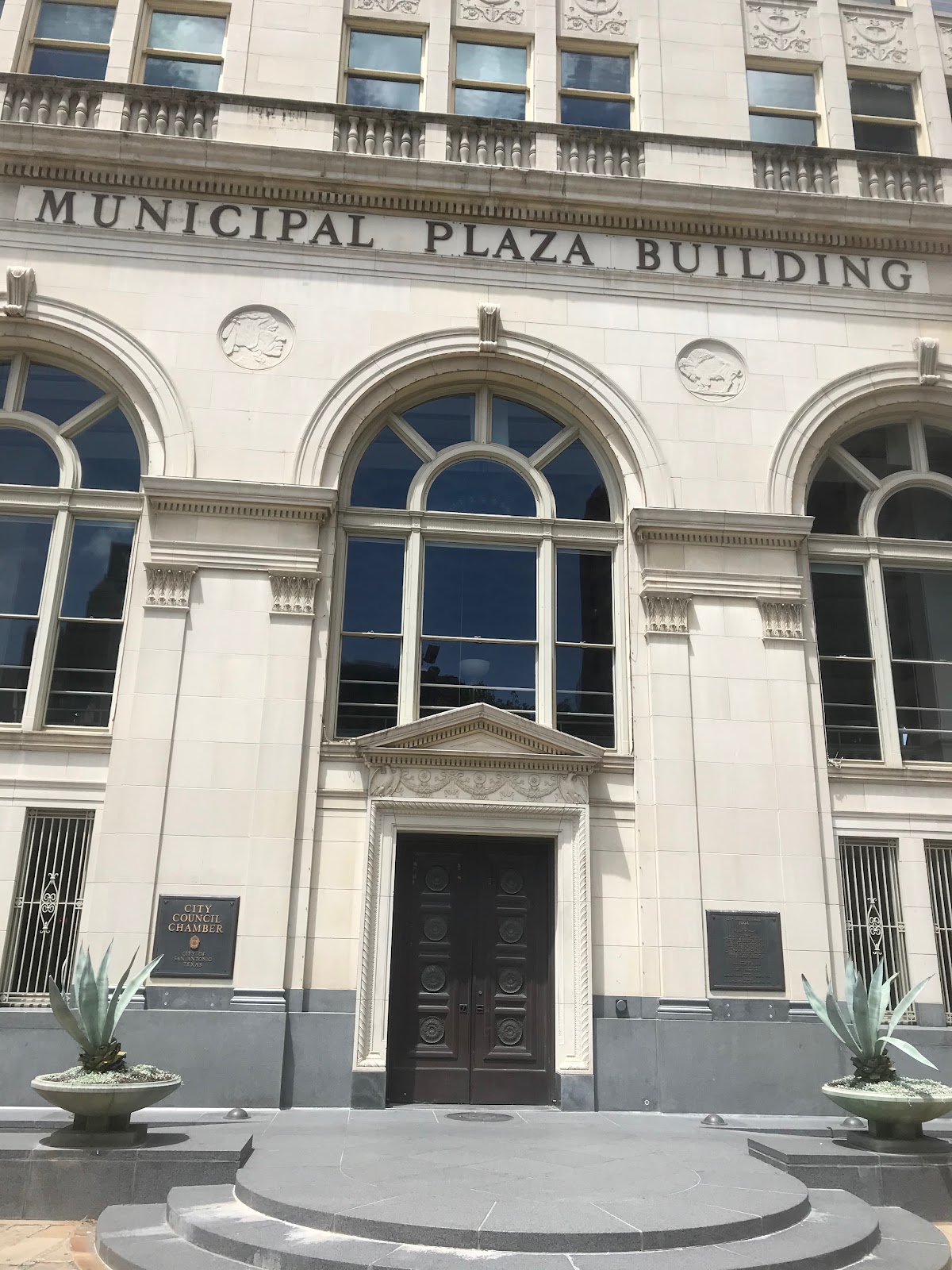
Staats firm, located on Main Plaza next to San Fernando Cathedral.  This building now houses the San Antonio City Council Chambers and has medallions of the nickel's two faces both on three sides of its facade, and inside, on the chamber's mezzanine.  The other is on the interior frieze right below the coffered ceiling of the 1930 San Antonio Public Library Building's lobby designed by Herbert S. Green, now the Briscoe Museum of Western Art.


Both the coffering and the frieze below it had been obscured, blackened by cigar smoke and pure neglect, and in the time that the building served as the Hertzberg Circus Museum between 1968 and 2001, it seems nobody looked upwards, the room being filled by circus paraphenalia.  When the structure was renovated more than a decade later in preparation for its transformation into the Briscoe Museum, the rich, but battered original ceiling was revealed.  Lake Flato Architects designed the new adjacent Guenther Pavilion, and Restoration Associates lovingly restored the original library building, including the art deco light fixtures, sumptuous coffered ceiling of gilded cast plaster, and its buffalo nickel frieze of the same material but in silver--a serendipitous find for a Western themed museum!


Now re-gilded with silver mica pigment, the alternating nickel faces with decorative framing (and some decorated fire spigots as well as plain disks punctuating them) shine again and can be seen in closeup on the Mezzanine level.  The Native American profile head and the bison, its curving posture gracefully fitting its circular shape, and even their smooth surfaces, suggesting some wear as found on most of the circulating nickels help tie the structure and its new function together. Their silvery coloring contrasts with the gold of the pilaster capitals below them and the coffering above.  There are no issue dates or inscriptions as found on the real coins, or the subtle variations the real coin suffered over the years of its issue, just the two emblematic images.


The collection of the Briscoe  offers numerous depictions of bison, including the Hulking Bull Bison, by Ken Ullman located on the Presa Street side of the Museum. But what makes the buffalo nickel theme even more important for the Briscoe is the presence in their collection of two works, one in a suite of prints, the other a pair of sculptures that invoke the same coin.


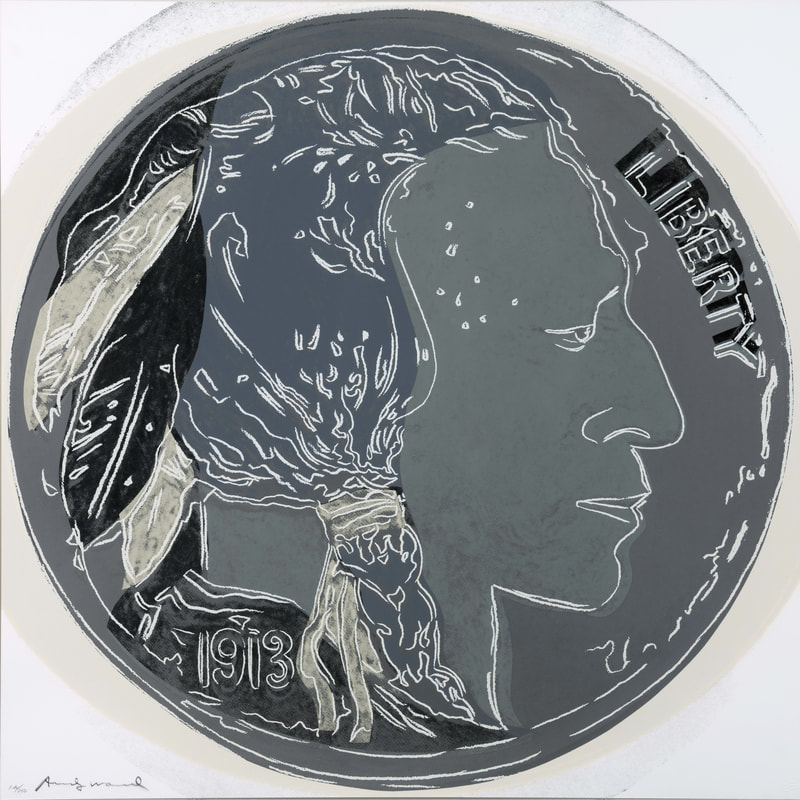
The prints are two serigraphs by Andy Warhol from the series Cowboys and Indians, published in 1986, a year before the artist's death.  The full portfolio in an edition of 250 consisting of ten images of Western heroes taken from existing photographs selected by Warhol and also several Native American artifacts that he photographed at the Museum of the American when it was still located in New York, plus the "Indian Head" side of the Buffalo Nickel.  The bison face of the nickel was included in a set of four additional proofs printed in a more limited edition of 46 in various colors.  The Briscoe Museum has both sets.

.

The serigraph or silk screen process produces multiple compositions of flat color, though color shade hatching can be achieved by the use of various screens. Because it is a multiple process, the color of individual prints of each composition can be varied. 


The two faces of Warhol's nickels are very limited in color, in contrast to the pop-art bright hues of other prints in the series (though in some of the other trial proofs, he experimented with bright colors).  The Briscoe's "Indian Head" uses two shades of gray, with black and white outlines and accents.  The model must have a coin of the first year of issue, for it bears a date of "1913." Warhol also reproduces the word "Liberty" found on the coin. He has taken a few liberties with his design, the "3" being rounded rather than the flat-topped one on the coin, and the figure's features are flatter, with the eye more defined.  Darker accents are in some of the feathers, the chief's collar, and behind part of the "Liberty" inscription, while white accents other feathers and the outlines of the profile and hair; the hair itself is a slightly darker gray than the skin. White and black lines and areas suggest slight wear.


The bison is similarly treated, though here the animal is darker gray than the ground it stands on, and the background is largely an off-white, as if the coin was seen in a raking light.  The mottled ground and the black behind the upper text of "United States of America" and "E Pluribus Unum" also suggests wear, while white lines and some black smudges give the animal a slight sense of depth.  The "Five Cents" below its feet are more irregular than that of the coin.


 Taken all together, the two prints achieve both the characteristically surface-oriented style of all of Warhol's works and capabilities of the medium, and the iconic logo-quality of a coin.  Given his inclination to often print multiples within the same compositions, such has his well-known "Campbell's Soup" prints, Warhol could have very well done a frieze of nickels himself.


The last nickel interpretation in the Briscoe couldn't be any more different from Warhol's, except that the fact that it was made by its artist in a multiple edition, in this case seventeen to twenty-one at a time.  These are the Indian Head and Buffalo sculptures in cast metal by Greg Woodard. There are two editions of each, one in steel and another, subsequent one in bronze. 


Though cast in multiples, Woodard applies patina to each piece individually, so that each is subtly different. These images are fully and sometimes jaggedly three dimensional.  It's as if the artist managed to inflate both Native American and Bison not only to their full volumes, but he did it so powerfully that he burst through and shattered their circular frames and their inscriptions too. The bison is fully visible from both sides since the circle is blown out, and its rough coat made to appear even rougher by its varied patina. Most of the inscription "United States of America" can be seen at its tattered top, while the "Five Cents" at the bottom is intact.  But Woodward has gone further, by giving us a view of the non-existent but hypothetical other side, he has included the word "Liberty" here--actually to be seen on Chief side of the real coin.  On this side, he has also provided some dusty ground beneath the bison's feet--perhaps a reference to the rough ground seen in the original 1913 nickel, which disappeared in later dies of the coin. In some states of the casting, the bison's head projects beyond the nickel's circular shape.


The cast of the Native American seems to have exploded its frame even more, so the upper circle is partially broken off.  Most of the head is placed in front of the broken circle; again, it is completely three dimensional. "LIB," a fragment of the word "Liberty" is stuck to the chief's forehead, while part of the inscription "United States" from the bison side is seen on the broken circular section beneath his neck, while the date "1913 is to the left of that. As in the case of the Warhol, the chief's hair is darker than his face, but here it is much darker.  Like Woodard's Bison, the surfaces are craggier, even to the point of a gouge out of the chief's cheek: this is a sculpture, after all, not the person himself.


Woodard has done other deconstructed coins; the Indian Penny, with this chief's war bonnet projecting far above the round coin boundary, and the Lincoln Penny, where the President appears in front of the coin, here reduced to a crescent moon.  The two sides of the Buffalo Nickel and the Indian Nickel are the only ones at least so far inspired by both faces of the coin.


No viewer can have trouble identifying the source for all the three examples in the museum discussed here, even though by the present date, few if any buffalo nickels remain in circulation.Given the western art mission of the museum, nothing could be more appropriate, tying works of art with a utilitarian United States currency.  It is also a really appropriate choice as the Briscoe's advertising logo!

______________________________________________________


Wikipedia's article on the Buffalo Nickel is a reliable source for the coin's history: https://en.wikipedia.org/wiki/Buffalo_nickel


For the Nickels on the City Council Building, see: http://txstartrail.com/OldFrostBankMunicipalPlazaBuilding1922.php


For the restoration of the Library for the Briscoe Museum: https://www.mysanantonio.com/entertainment/arts-culture/article/Buildings-blend-old-new-with-eye-on-history-4905025.php


An excellent discussion of Warhol's Buffalo Nickels and the entire print set is available is the thesis by Seth Hopkins, director of the Booth Museum, available on the Volgistics site for Briscoe docents.  An additional discussion of Hopkins and his interest in Warhol can be found at: https://www.forbes.com/sites/chaddscott/2019/09/24/booth-western-art-museum-sheds-new-light-on-andy-warhol-with-exhibit-warhol-and-the-west/#1276b08c4609


Information on Greg Woodard is available through the website of his principal gallery, Altamira Fine Arts: https://www.altamiraart.com/artists/5-greg-woodard/biography/, and Woodard's works: https://www.altamiraart.com/artists/5-greg-woodard/works/

Dastardly Deeds in the Briscoe Museum: The Nueces Strip, Saddles and a Saloon


Michael Unteidt: On the Nueces Strip: Rangers and Another Heye Saddle


A man gallops his horse up a dusty path.  Judging by the starry sky, it's night, but there must be a full moon because the rider casts a moon-shadow on the trail.  The rider looks back at two pursuing men, also riding full tilt, trying to catch him.  The backward glance of the of the horseman suggests anxiety; this mood is further heightened by the diagonal of the hill behind him and inclined poses, echoing the diagonal, of the two pursuers just cresting the hill. Way in the background are some darker hills with a few lights of a town at their base.  The brushstrokes are broad, impressionistic.  In spite of the fugitive’s red shirt, moonlight makes the colors cool and ghostly.  Though it is night, and stars dot the sky, it's more like Hollywood theatrical day-for-night than a true moonlit landscape.

 The painter of this work is Michael Ome Untiedt, a contemporary Western artist, and this work, entitled On the Nueces Strip: Rangers and Another Heye Saddle, is relatively recent (2014).  A lot of Untiedt’s work falls in the western genre.  Some of them have historical figures such as Charlie Goodnight and Quanah Parker.  Sometimes he repeats the story, as

Unteidt: Lads Ride Lightly a Heys Saddle (Private Collection)

he did here with 
Lads, Ride Lightly, a Heys [sic] Saddle, with a darker palette, the figures more centered, and small trees to left and right.  Sometimes two almost identical compositions have divergent backstories, for example, On the Nueces Strip is very similar to another of his works, When Faith Takes a Fast Mount, where there is only one pursuer, the weather is stormy rather than nocturnal, and a crucifix is on a low hill to the right.  On his website, the painter comments on many of his works, accompanied by photographs of them.  Quite a number are night scenes; he gives tribute in these to earlier Western painters in the genre: Frederic Remington and Frank Tenney Johnson.  Many of them are general nostalgic scenes of cowboy life, others are pure but recognizably western landscapes, and all appear to narrate something, identifiable or not.

 The title “On the Nueces Strip: Rangers and Another Heye Saddle” as well as its sister composition, and their mood of pursuit and anxiety certainly implies a specific story being told here, but unless you happen to be a die-hard Texas history buff, you are probably asking “Nueces Strip?  Where is that?”  “Heye Saddle—is it a type of saddle, or does it refer to one owned by somebody named Heye, or made by Heye?  As for Texas Rangers: Walker? That ball club in Arlington?


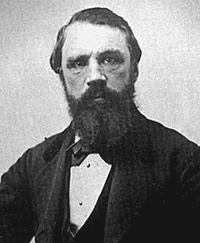
The particular incident referred to is a real one: a robbery of a general store on the Nueces River, the theft of eighteen valuable saddles among the loot, and the story of their recovery in 1875.  The Nueces River, which flows from Edwards County in central Texas to Corpus Christi Bay, was considered the boundary between Mexico and Texas, until Texas, the winner of the Mexican American war of 1846-1848 definitively fixed this border southward at the Rio Grande with the Treaty of Guadalupe Hidalgo.  But there were many Mexican citizens who had had ancestral land grants in the “Nueces Strip”—the area between the two rivers.  They still considered these holdings their own, even as Anglo-American settlers began to populate the territory and appropriate property for themselves.  Conflict in the region raged for another thirty years or more.  One of the biggest Mexican land-grant leaders, Juan Nepumaceno Cortina, lost a considerable amount of family property north of the Rio Grande in the vicinity of Brownsville.  He became the leader of disenfranchised Mexicans in the region and fought two local wars during the period 1859-1861 before he was driven back over this newer border.  


From the end of the Civil War and later, as Anglo-American ranches were being established, great numbers of feral longhorn cattle were rounded up, claimed by the
Juan Nepumaceno Cortina

ranchers, and branded with their brands.  After 1870 Cortina became active again, directing raids into the Nueces strip area, stealing cattle and looting Anglo-American settlements and ranches, taking all of it across the Rio Grande to Mexico.  To Mexicans, he was Robin Hood.  To many Anglo-Americans, he was more like Attila the Hun.


This is not the place to talk about the Texas Rangers, a sort of Texan “Special Forces” with a long and checkered history; just to mention one short part of it. A company of Rangers was commissioned by Texas Governor Edmund J. Davis to settle a long-standing feud between the Sutton and Taylor families in south Texas in 1874.  It was commanded by 30-year-old Captain Leander McNelly, a Civil War veteran and former state policeman.  Though they were only partially successful, McNelly was called to action.*

Captain McNelly

again in 1875 to try and establish some law and order in the Nueces Strip. He recruited forty men, and for the next two years, often using brutal and unorthodox methods (McNelly was a disciple of the “take-no-prisoners-school), they succeeded.  For a detailed account of their activities at this time from the Rangers' point of view, I recommend the account of the youngest member of the company, George Durham called "Taming the Nueces Strip.”


Untiedt’s paintings invoke this campaign.  The San Antonio Daily Express sounded a general alarm about the threatening situation on the Nueces Strip on May, 20, 1875.  Cortina sent out four groups of marauders consisting of Mexicans and some allied Anglo American over the border five days later.  Three were soon repulsed, but the fourth group charged north, heading towards Corpus Christi.  On the way, they destroyed ranches and homesteads, raided a store run and owned by George Franks, and took some prisoners of both genders, driving them in front as human shields and/or bargaining chips.


On March 26 (Good Friday), they reached Nuecestown, a small place then, and now absorbed into Corpus Christi.  There, they attacked the general store owned by Thomas J. Noakes, who was also the town’s postmaster. In his words in a dispatch to The Galveston Daily News on March 30th:


"I took aim at the nearest of the cutthroats in the store. When I discovered  about fifty outside, I did not shoot, knowing that I was overpowered and my only chance for life was to secrete myself in a subterranean passage.... The robbers completely sacked my store of all valuables."   


 A much more detailed account was written by Noakes on May 13, and reproduced in full in "The Mexican Raid on Corpus Christi" by Leopold Morris (see citation below). Noakes, knowing of the local potential for disaster, had dug a tunnel under the house, where he hid after shooting one of the robbers, and then realizing the overwhelming odds against him.  His five children escaped to the river, but Noakes’s wife Martha took a stand.  As the robbers attempted to set fire to the store, she managed to douse it twice before ducking inside to grab her feather comforter and sewing machine.  One of the Anglo robbers, described by her with a distinctive facial scar, beat her severely with his riding quirt, but she eventually escaped, featherbed quilt and all.  T.J. Noakes and all the children survived as well, but the store was not only sacked but burned before the bandits rode away.


Among their haul were eighteen luxury saddles, heavily adorned with silver in distinctive pattern and design, manufactured by Diedrich Heye of San Antonio.


This robber band was prevented by traveling further by a posse who came down from Corpus Christi, and other armed locals.  Retribution was evidently very intense and violent but did nothing to stop the lawless carnage between both Mexicans and Anglos in the region over the next month.


According to George Durham, when NcNelly and his rangers arrived at Nuecestown and the site of the burned store, he gave his men very specific instructions.


 "Captain seemed mighty concerned about those eighteen saddles.  He got Mike Dunn [one of the prisoners the posse freed from the gang after the     raid] to give him a good picture of them—length of the tapideros, if the skirts were cinched.  He wanted all details…and ordered: 'Describe those    saddles to the Rangers.  Make sure they understand exactly. Then order them to empty those saddles on sight.  No palavering with the riders.  Empty them.  Leave the men where you drop them and bring the saddles to camp.'”


The following month, McNelly and his rangers caught up with many of the raiders at the salt marsh of Palo Alto, north of Brownsville. He and his men slaughtered them all—and George himself killed the scar-faced man who beat up Mrs. Noakes.  McNelly had the bodies brought back to Brownsville and stacked them in a public square—shocking friends as well as the unsympathetic.  A tally of the loot recaptured from the battle included twenty-two pistols, twelve rifles and fourteen saddles.  Durham reported: 


 Nine of the saddles…look to be almost brand new.  they are dandies.  Garnished with two-inch silver conchos, foot-long tapaderos.  The first ones I’ve seen.  Came from Dick Heye saddlery in Santone. Captain perked up and said, ‘Let’s have a look at them.  Sounds like they’re part of the plunder taken up in Nuecestown in a raid last March.' They were. No mistaking them.


Befitting their special value, Cortina had given them to his trusted and honored lieutenants. McNelly, in the instructions to his men, practiced what art historians call “connoisseurship:” analyzing the traits of a distinctive style to determine the authenticity of a work of art.  It worked for the art of saddles too.


McNelly died young at 33.  He had been suffering from tuberculosis and had originally migrated to Texas from Louisiana in search of drier air.  He lived long enough to conduct more skirmishes along the Rio Grande, including one over the border into Mexico itself.  The Nueces Strip was eventually pacified, but the Rio Grande is, to this day as we well know, a volatile border.


T.J. Noakes got these saddles back—and eventually all eighteen—plus seven more!  They were evidently prized targets.  The problem was, according to Durham at least, that these particular ones had morphed from notable to notorious—no one wanted to buy them, given their history.


So who knows which incident in this border war involving Heye saddles, if any, is the specific pursuit depicted in Untiedt’s painting? Well, the artist himself says so, and describes the lore of the story as he heard it on his website. But neither painted versions is a direct narrative, they're more a poetic narration of pursuit—and for this writer, a lot more

Melvin C. Warren: On the Nueces Strip 

moving and impressive than such standard “western issue” paintings depicting Captain McNelly by Joe Grandee or Clyde Heron, or the  painting entitled The Nueces Strip by Melvin C. Warren  of 1973, also at the Briscoe, in the Janey Briscoe Marmion Collection. featuring two Texas Rangers in a South Texas landscape dressed in more recent western wear, with the signature Texas Ranger badge made from a 5 peso coin, These badges didn’t come into general use by the Rangers until after 1900.


Part of the irony of it all, is that no part of the saddle and its rich adornments is visible in either painting, but visitors to the gallery at the Briscoe where the painting is hung can examine a genuine Heye saddle, with all its silver concho trimmings (Durham mentions that these were particularly large), and characteristically long and silver-plated tapaderos (stirrup covers) on display in the same room.


The Heye Saddlery on Commerce Street


It would be wonderful to say that this particular saddle was actually part of the Nuecestown loot, but it isn’t, for the firm of D. Heye and his sons kept the enterprise going well into second third of the 20th century.  Diedrich Heye was part of a wave of German settlers who came to central Texas during the mid-19th century.  Born in Holstein in 1837, he received his initial training in saddlery in his native country, then moved on to an apprenticeship in England, which had the reputation for being the best in the business.  He then went to Mexico City, where he learned the art of silver-decorated saddles, the basis for the American western saddle.  He came to San Antonio in 1866, where he set up a shop on Commerce Street, then the principal business street in the city.  He and his workers quickly

built up a reputation for quality saddlery and prospered in the period of the cattle drives during the next two decades.  The firm produced work saddles too, but the Heye saddle became the darling of wealthy stockmen, with their distinctive concho pattern and quality leather work (Durham called them “the Cadillac of Saddles).”


Heye died in 1896, but he had taught his trade to his sons, and later the business was continued by his grandson.  Among other projects, the Heye enterprise made many of the saddles for Teddy Roosevelt’s Rough Riders, who trained in San Antonio. Later they became saddle makers to Hollywood cowboy stars and wealthy ranchers, and as automobiles displaced horses as transportation, they branched out into all sorts of luxury leather goods, including fancy luggage.


Over their long business operation, the enterprise moved several times to larger quarters, but the upper facade of the original workshop is marked by a commemorative sign that still reads “G. Heye, Est. 1867” (it is now occupied by the Coyote Ugly Saloon).

Heye's Rex Stuart Saddle
The saddle on exhibition at the Briscoe Museum was made for Rex Stuart, a now-forgotten country singer who was popular in the mid-20th century, and so was presumably custom made at that time.  It has the characteristic conchos and silver-adorned tapaderos.  I can’t say how closely it resembled the Diedrich (or Dick) Heye saddles of the 1870’s, but I think it’s great that it occupies the same gallery as Untiedt’s painting, so you can really understand what the painter’s reference is.


But it gets even better: the D. Heye original San Antonio saddlery site, nicely marked, is just one block north of the Briscoe Museum—you could even see it from a window in the gallery if it weren’t blocked by a parking garage.  For Art Historians, it is completely rare for a work of art, its iconographical source and the location of its origins are all in the same place.  We should all go to Coyote Ugly after a Briscoe Museum visit and raise a glass to Heye, McNelly, Untiedt and brave Martha too!


Heye Saddlery- Now Coyote Ugly Bar

______________

*The First State Bank in Uvalde, in which the Briscoe Family has controlling interest, contains two portraits of McNelly in its collection, one by Joe R. Grandee, the other by David Sanders.  They can be seen on the bank.s website: https://www.fsbuvalde.com/online-gallery.aspx#GardenersDaughter

Michael Ome Unteidt's Personal Website:   https://michaeluntiedt.weebly.com
  
There are numerous recountings of the attack on the Nuecestown Store.  Though it was written down nearly 50 years after it happened, there is an eyewitness account by former "Little McNelly" George Durham made in 1934, and finally published in 1962:
George Durham (told to Clyde Wantland), The Story of McNelly's Rangers, Austin, University of Texas, 1962.
Other accounts include:
*Leopold Morris, "The Mexican Raid on Corpus Christi,"The Quarterly of the Texas State Historical Association," Vol.4, #2 (October 1900), pp. 128-39.
*William A. Hager, "The Nuecestown Raid of 1875: A Border Incident," Arizona and the West, #3 (Autumn 1959, pp. 258-270.

Noakes's account in the Galveston News: "Statement of the Postmaster at Nueces: A Narrow Escape From Death,"  March 30, 1875, p.1.
The Salt Marsh Battle: "Letter from Brownsville, San Antonio Express, May 29, 1875, p. 16.



William Herbert Dunton (otherwise known as Buck), Illustrator

  William Herbert Dunton (otherwise known as Buck), Illustrator     William H. Dunton: Vaquero (1909); Briscoe Museum                   He s...