The Briscoe Museum and its Buffalo Nickels


             The Briscoe Museum of Western Art has as its logo an American Bison inscribed within a circle.  It clearly invokes the "Buffalo/Indian Head" nickel, one of the most iconic of U.S. coins of the 20th century.  The coin was minted between 1913 and 1938.  It was also one of the most problematic. There was a challenge to the design submitted by James Earle Frazer in 1912 by the Hobbs company, since they feared that their detection machines couldn't distinguish between the authentic nickel and slugs, which delayed its release by a year. Problems with its indistinct striking caused them to wear out quickly, no matter what modifications were made to their design over the years, do new dies had to be made more often than usual..

On the other hand, the nickels proved popular.  Frazer already had a sound reputation as a sculptor and is probably best remembered for his highly acclaimed work End of the Trail. At the time of the coin's release, there was speculation as to which Native American leader and 

which particular bison were Frazer's models: the head of the chief proved to be a composite, and the bison model apparently came from the Central Park Zoo in New York City.  They continued to be in circulation for at least two decades after the Mint switched to the Jefferson 

design in 1938


As an architectural motif, they were popular during the 1920's and 1930's, the period of 

the art deco style in many civic-minded buildings all over the United States, including two in San Antonio. The earlier one is the Frost Bank building designed in 1922 by the Sanguinett and
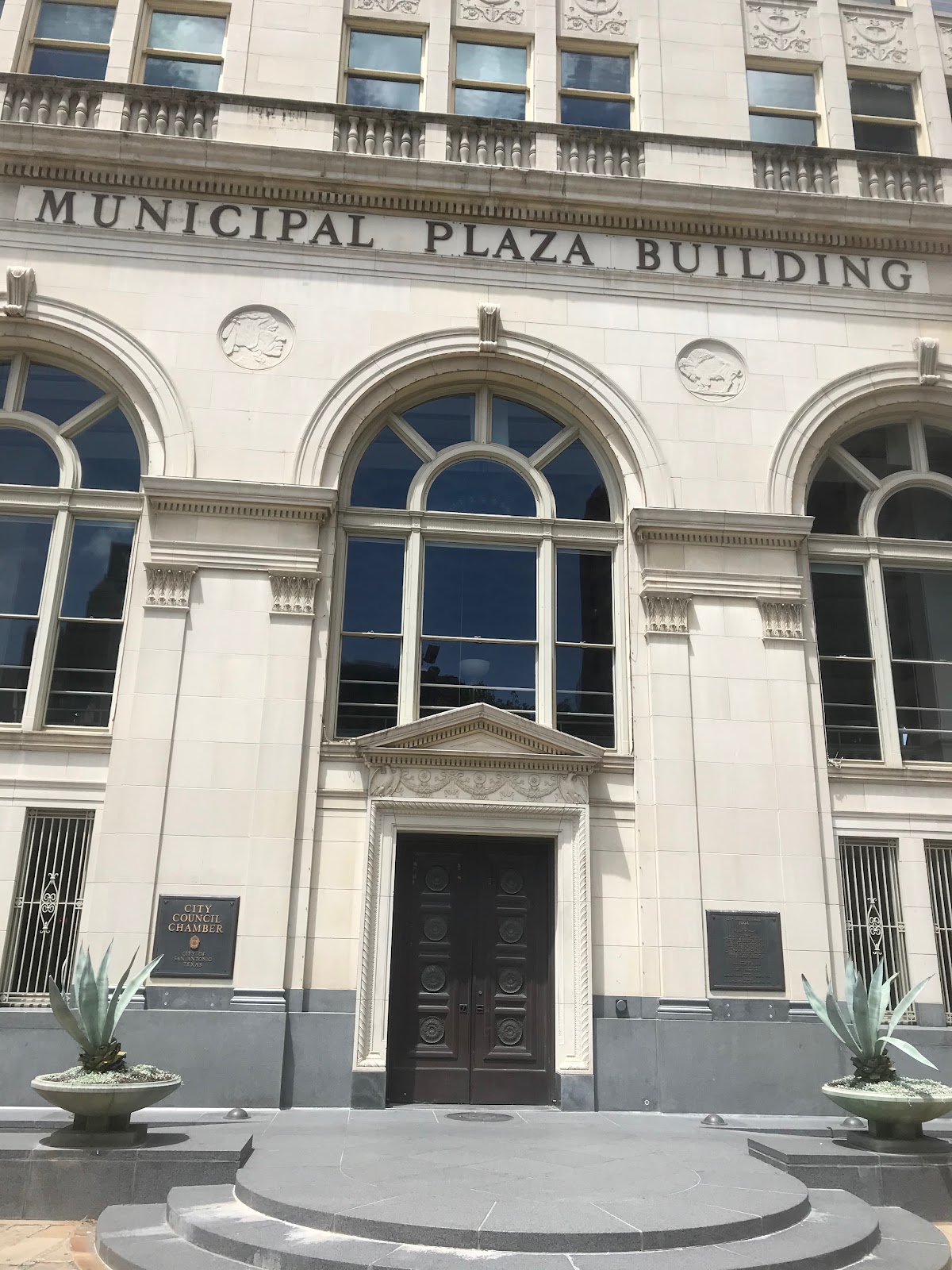


Staats firm, located on Main Plaza next to San Fernando Cathedral.  This building now houses the San Antonio City Council Chambers and has medallions of the nickel's two faces both on three sides of its facade, and inside, on the chamber's mezzanine.  The other is on the interior frieze right below the coffered ceiling of the 1930 San Antonio Public Library Building's lobby designed by Herbert S. Green, now the Briscoe Museum of Western Art.


Both the coffering and the frieze below it had been obscured, blackened by cigar smoke and pure neglect, and in the time that the building served as the Hertzberg Circus Museum between 1968 and 2001, it seems nobody looked upwards, the room being filled by circus paraphenalia.  When the structure was renovated more than a decade later in preparation for its transformation into the Briscoe Museum, the rich, but battered original ceiling was revealed.  Lake Flato Architects designed the new adjacent Guenther Pavilion, and Restoration Associates lovingly restored the original library building, including the art deco light fixtures, sumptuous coffered ceiling of gilded cast plaster, and its buffalo nickel frieze of the same material but in silver--a serendipitous find for a Western themed museum!


Now re-gilded with silver mica pigment, the alternating nickel faces with decorative framing (and some decorated fire spigots as well as plain disks punctuating them) shine again and can be seen in closeup on the Mezzanine level.  The Native American profile head and the bison, its curving posture gracefully fitting its circular shape, and even their smooth surfaces, suggesting some wear as found on most of the circulating nickels help tie the structure and its new function together. Their silvery coloring contrasts with the gold of the pilaster capitals below them and the coffering above.  There are no issue dates or inscriptions as found on the real coins, or the subtle variations the real coin suffered over the years of its issue, just the two emblematic images.


The collection of the Briscoe  offers numerous depictions of bison, including the Hulking Bull Bison, by Ken Ullman located on the Presa Street side of the Museum. But what makes the buffalo nickel theme even more important for the Briscoe is the presence in their collection of two works, one in a suite of prints, the other a pair of sculptures that invoke the same coin.
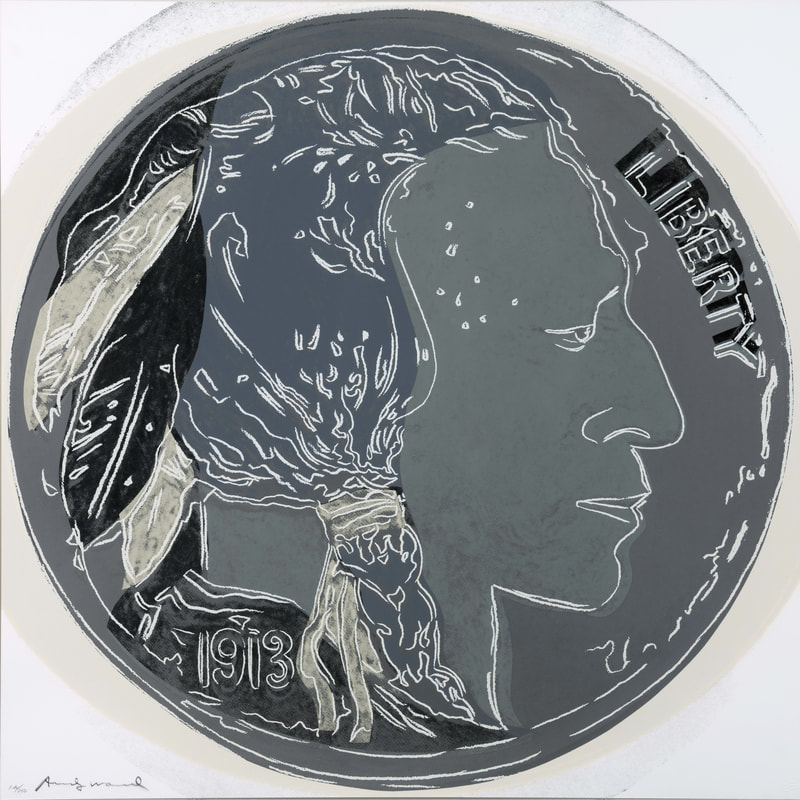


The prints are two serigraphs by Andy Warhol from the series Cowboys and Indians, published in 1986, a year before the artist's death.  The full portfolio in an edition of 250 consisting of ten images of Western heroes taken from existing photographs selected by Warhol and also several Native American artifacts that he photographed at the Museum of the American when it was still located in New York, plus the "Indian Head" side of the Buffalo Nickel.  The bison face of the nickel was included in a set of four additional proofs printed in a more limited edition of 46 in various colors.  The Briscoe Museum has both sets.

.

The serigraph or silk screen process produces multiple compositions of flat color, though color shade hatching can be achieved by the use of various screens. Because it is a multiple process, the color of individual prints of each composition can be varied. 


The two faces of Warhol's nickels are very limited in color, in contrast to the pop-art bright hues of other prints in the series (though in some of the other trial proofs, he experimented with bright colors).  The Briscoe's "Indian Head" uses two shades of gray, with black and white outlines and accents.  The model must have a coin of the first year of issue, for it bears a date of "1913." Warhol also reproduces the word "Liberty" found on the coin. He has taken a few liberties with his design, the "3" being rounded rather than the flat-topped one on the coin, and the figure's features are flatter, with the eye more defined.  Darker accents are in some of the feathers, the chief's collar, and behind part of the "Liberty" inscription, while white accents other feathers and the outlines of the profile and hair; the hair itself is a slightly darker gray than the skin. White and black lines and areas suggest slight wear.


The bison is similarly treated, though here the animal is darker gray than the ground it stands on, and the background is largely an off-white, as if the coin was seen in a raking light.  The mottled ground and the black behind the upper text of "United States of America" and "E Pluribus Unum" also suggests wear, while white lines and some black smudges give the animal a slight sense of depth.  The "Five Cents" below its feet are more irregular than that of the coin.


 Taken all together, the two prints achieve both the characteristically surface-oriented style of all of Warhol's works and capabilities of the medium, and the iconic logo-quality of a coin.  Given his inclination to often print multiples within the same compositions, such has his well-known "Campbell's Soup" prints, Warhol could have very well done a frieze of nickels himself.


The last nickel interpretation in the Briscoe couldn't be any more different from Warhol's, except that the fact that it was made by its artist in a multiple edition, in this case seventeen to twenty-one at a time.  These are the Indian Head and Buffalo sculptures in cast metal by Greg Woodard. There are two editions of each, one in steel and another, subsequent one in bronze. 


Though cast in multiples, Woodard applies patina to each piece individually, so that each is subtly different. These images are fully and sometimes jaggedly three dimensional.  It's as if the artist managed to inflate both Native American and Bison not only to their full volumes, but he did it so powerfully that he burst through and shattered their circular frames and their inscriptions too. The bison is fully visible from both sides since the circle is blown out, and its rough coat made to appear even rougher by its varied patina. Most of the inscription "United States of America" can be seen at its tattered top, while the "Five Cents" at the bottom is intact.  But Woodward has gone further, by giving us a view of the non-existent but hypothetical other side, he has included the word "Liberty" here--actually to be seen on Chief side of the real coin.  On this side, he has also provided some dusty ground beneath the bison's feet--perhaps a reference to the rough ground seen in the original 1913 nickel, which disappeared in later dies of the coin. In some states of the casting, the bison's head projects beyond the nickel's circular shape.


The cast of the Native American seems to have exploded its frame even more, so the upper circle is partially broken off.  Most of the head is placed in front of the broken circle; again, it is completely three dimensional. "LIB," a fragment of the word "Liberty" is stuck to the chief's forehead, while part of the inscription "United States" from the bison side is seen on the broken circular section beneath his neck, while the date "1913 is to the left of that. As in the case of the Warhol, the chief's hair is darker than his face, but here it is much darker.  Like Woodard's Bison, the surfaces are craggier, even to the point of a gouge out of the chief's cheek: this is a sculpture, after all, not the person himself.


Woodard has done other deconstructed coins; the Indian Penny, with this chief's war bonnet projecting far above the round coin boundary, and the Lincoln Penny, where the President appears in front of the coin, here reduced to a crescent moon.  The two sides of the Buffalo Nickel and the Indian Nickel are the only ones at least so far inspired by both faces of the coin.


No viewer can have trouble identifying the source for all the three examples in the museum discussed here, even though by the present date, few if any buffalo nickels remain in circulation.Given the western art mission of the museum, nothing could be more appropriate, tying works of art with a utilitarian United States currency.  It is also a really appropriate choice as the Briscoe's advertising logo!

______________________________________________________


Wikipedia's article on the Buffalo Nickel is a reliable source for the coin's history: https://en.wikipedia.org/wiki/Buffalo_nickel


For the Nickels on the City Council Building, see: http://txstartrail.com/OldFrostBankMunicipalPlazaBuilding1922.php


For the restoration of the Library for the Briscoe Museum: https://www.mysanantonio.com/entertainment/arts-culture/article/Buildings-blend-old-new-with-eye-on-history-4905025.php


An excellent discussion of Warhol's Buffalo Nickels and the entire print set is available is the thesis by Seth Hopkins, director of the Booth Museum, available on the Volgistics site for Briscoe docents.  An additional discussion of Hopkins and his interest in Warhol can be found at: https://www.forbes.com/sites/chaddscott/2019/09/24/booth-western-art-museum-sheds-new-light-on-andy-warhol-with-exhibit-warhol-and-the-west/#1276b08c4609


Information on Greg Woodard is available through the website of his principal gallery, Altamira Fine Arts: https://www.altamiraart.com/artists/5-greg-woodard/biography/, and Woodard's works: https://www.altamiraart.com/artists/5-greg-woodard/works/

Dastardly Deeds in the Briscoe Museum: The Nueces Strip, Saddles and a Saloon


Michael Unteidt: On the Nueces Strip: Rangers and Another Heye Saddle


A man gallops his horse up a dusty path.  Judging by the starry sky, it's night, but there must be a full moon because the rider casts a moon-shadow on the trail.  The rider looks back at two pursuing men, also riding full tilt, trying to catch him.  The backward glance of the of the horseman suggests anxiety; this mood is further heightened by the diagonal of the hill behind him and inclined poses, echoing the diagonal, of the two pursuers just cresting the hill. Way in the background are some darker hills with a few lights of a town at their base.  The brushstrokes are broad, impressionistic.  In spite of the fugitive’s red shirt, moonlight makes the colors cool and ghostly.  Though it is night, and stars dot the sky, it's more like Hollywood theatrical day-for-night than a true moonlit landscape.

 The painter of this work is Michael Ome Untiedt, a contemporary Western artist, and this work, entitled On the Nueces Strip: Rangers and Another Heye Saddle, is relatively recent (2014).  A lot of Untiedt’s work falls in the western genre.  Some of them have historical figures such as Charlie Goodnight and Quanah Parker.  Sometimes he repeats the story, as

Unteidt: Lads Ride Lightly a Heys Saddle (Private Collection)

he did here with 
Lads, Ride Lightly, a Heys [sic] Saddle, with a darker palette, the figures more centered, and small trees to left and right.  Sometimes two almost identical compositions have divergent backstories, for example, On the Nueces Strip is very similar to another of his works, When Faith Takes a Fast Mount, where there is only one pursuer, the weather is stormy rather than nocturnal, and a crucifix is on a low hill to the right.  On his website, the painter comments on many of his works, accompanied by photographs of them.  Quite a number are night scenes; he gives tribute in these to earlier Western painters in the genre: Frederic Remington and Frank Tenney Johnson.  Many of them are general nostalgic scenes of cowboy life, others are pure but recognizably western landscapes, and all appear to narrate something, identifiable or not.

 The title “On the Nueces Strip: Rangers and Another Heye Saddle” as well as its sister composition, and their mood of pursuit and anxiety certainly implies a specific story being told here, but unless you happen to be a die-hard Texas history buff, you are probably asking “Nueces Strip?  Where is that?”  “Heye Saddle—is it a type of saddle, or does it refer to one owned by somebody named Heye, or made by Heye?  As for Texas Rangers: Walker? That ball club in Arlington?


The particular incident referred to is a real one: a robbery of a general store on the Nueces River, the theft of eighteen valuable saddles among the loot, and the story of their recovery in 1875.  The Nueces River, which flows from Edwards County in central Texas to Corpus Christi Bay, was considered the boundary between Mexico and Texas, until Texas, the winner of the Mexican American war of 1846-1848 definitively fixed this border southward at the Rio Grande with the Treaty of Guadalupe Hidalgo.  But there were many Mexican citizens who had had ancestral land grants in the “Nueces Strip”—the area between the two rivers.  They still considered these holdings their own, even as Anglo-American settlers began to populate the territory and appropriate property for themselves.  Conflict in the region raged for another thirty years or more.  One of the biggest Mexican land-grant leaders, Juan Nepumaceno Cortina, lost a considerable amount of family property north of the Rio Grande in the vicinity of Brownsville.  He became the leader of disenfranchised Mexicans in the region and fought two local wars during the period 1859-1861 before he was driven back over this newer border.  


From the end of the Civil War and later, as Anglo-American ranches were being established, great numbers of feral longhorn cattle were rounded up, claimed by the

Juan Nepumaceno Cortina

ranchers, and branded with their brands.  After 1870 Cortina became active again, directing raids into the Nueces strip area, stealing cattle and looting Anglo-American settlements and ranches, taking all of it across the Rio Grande to Mexico.  To Mexicans, he was Robin Hood.  To many Anglo-Americans, he was more like Attila the Hun.


This is not the place to talk about the Texas Rangers, a sort of Texan “Special Forces” with a long and checkered history; just to mention one short part of it. A company of Rangers was commissioned by Texas Governor Edmund J. Davis to settle a long-standing feud between the Sutton and Taylor families in south Texas in 1874.  It was commanded by 30-year-old Captain Leander McNelly, a Civil War veteran and former state policeman.  Though they were only partially successful, McNelly was called to action.*

Captain McNelly

again in 1875 to try and establish some law and order in the Nueces Strip. He recruited forty men, and for the next two years, often using brutal and unorthodox methods (McNelly was a disciple of the “take-no-prisoners-school), they succeeded.  For a detailed account of their activities at this time from the Rangers' point of view, I recommend the account of the youngest member of the company, George Durham called "Taming the Nueces Strip.”


Untiedt’s paintings invoke this campaign.  The San Antonio Daily Express sounded a general alarm about the threatening situation on the Nueces Strip on May, 20, 1875.  Cortina sent out four groups of marauders consisting of Mexicans and some allied Anglo American over the border five days later.  Three were soon repulsed, but the fourth group charged north, heading towards Corpus Christi.  On the way, they destroyed ranches and homesteads, raided a store run and owned by George Franks, and took some prisoners of both genders, driving them in front as human shields and/or bargaining chips.


On March 26 (Good Friday), they reached Nuecestown, a small place then, and now absorbed into Corpus Christi.  There, they attacked the general store owned by Thomas J. Noakes, who was also the town’s postmaster. In his words in a dispatch to The Galveston Daily News on March 30th:


"I took aim at the nearest of the cutthroats in the store. When I discovered  about fifty outside, I did not shoot, knowing that I was overpowered and my only chance for life was to secrete myself in a subterranean passage.... The robbers completely sacked my store of all valuables."   


 A much more detailed account was written by Noakes on May 13, and reproduced in full in "The Mexican Raid on Corpus Christi" by Leopold Morris (see citation below). Noakes, knowing of the local potential for disaster, had dug a tunnel under the house, where he hid after shooting one of the robbers, and then realizing the overwhelming odds against him.  His five children escaped to the river, but Noakes’s wife Martha took a stand.  As the robbers attempted to set fire to the store, she managed to douse it twice before ducking inside to grab her feather comforter and sewing machine.  One of the Anglo robbers, described by her with a distinctive facial scar, beat her severely with his riding quirt, but she eventually escaped, featherbed quilt and all.  T.J. Noakes and all the children survived as well, but the store was not only sacked but burned before the bandits rode away.


Among their haul were eighteen luxury saddles, heavily adorned with silver in distinctive pattern and design, manufactured by Diedrich Heye of San Antonio.


This robber band was prevented by traveling further by a posse who came down from Corpus Christi, and other armed locals.  Retribution was evidently very intense and violent but did nothing to stop the lawless carnage between both Mexicans and Anglos in the region over the next month.


According to George Durham, when NcNelly and his rangers arrived at Nuecestown and the site of the burned store, he gave his men very specific instructions.


 "Captain seemed mighty concerned about those eighteen saddles.  He got Mike Dunn [one of the prisoners the posse freed from the gang after the     raid] to give him a good picture of them—length of the tapideros, if the skirts were cinched.  He wanted all details…and ordered: 'Describe those    saddles to the Rangers.  Make sure they understand exactly. Then order them to empty those saddles on sight.  No palavering with the riders.  Empty them.  Leave the men where you drop them and bring the saddles to camp.'”


The following month, McNelly and his rangers caught up with many of the raiders at the salt marsh of Palo Alto, north of Brownsville. He and his men slaughtered them all—and George himself killed the scar-faced man who beat up Mrs. Noakes.  McNelly had the bodies brought back to Brownsville and stacked them in a public square—shocking friends as well as the unsympathetic.  A tally of the loot recaptured from the battle included twenty-two pistols, twelve rifles and fourteen saddles.  Durham reported: 


 Nine of the saddles…look to be almost brand new.  they are dandies.  Garnished with two-inch silver conchos, foot-long tapaderos.  The first ones I’ve seen.  Came from Dick Heye saddlery in Santone. Captain perked up and said, ‘Let’s have a look at them.  Sounds like they’re part of the plunder taken up in Nuecestown in a raid last March.' They were. No mistaking them.


Befitting their special value, Cortina had given them to his trusted and honored lieutenants. McNelly, in the instructions to his men, practiced what art historians call “connoisseurship:” analyzing the traits of a distinctive style to determine the authenticity of a work of art.  It worked for the art of saddles too.


McNelly died young at 33.  He had been suffering from tuberculosis and had originally migrated to Texas from Louisiana in search of drier air.  He lived long enough to conduct more skirmishes along the Rio Grande, including one over the border into Mexico itself.  The Nueces Strip was eventually pacified, but the Rio Grande is, to this day as we well know, a volatile border.


T.J. Noakes got these saddles back—and eventually all eighteen—plus seven more!  They were evidently prized targets.  The problem was, according to Durham at least, that these particular ones had morphed from notable to notorious—no one wanted to buy them, given their history.


So who knows which incident in this border war involving Heye saddles, if any, is the specific pursuit depicted in Untiedt’s painting? Well, the artist himself says so, and describes the lore of the story as he heard it on his website. But neither painted versions is a direct narrative, they're more a poetic narration of pursuit—and for this writer, a lot more

Melvin C. Warren: On the Nueces Strip 

moving and impressive than such standard “western issue” paintings depicting Captain McNelly by Joe Grandee or Clyde Heron, or the  painting entitled The Nueces Strip by Melvin C. Warren  of 1973, also at the Briscoe, in the Janey Briscoe Marmion Collection. featuring two Texas Rangers in a South Texas landscape dressed in more recent western wear, with the signature Texas Ranger badge made from a 5 peso coin, These badges didn’t come into general use by the Rangers until after 1900.


Part of the irony of it all, is that no part of the saddle and its rich adornments is visible in either painting, but visitors to the gallery at the Briscoe where the painting is hung can examine a genuine Heye saddle, with all its silver concho trimmings (Durham mentions that these were particularly large), and characteristically long and silver-plated tapaderos (stirrup covers) on display in the same room.


The Heye Saddlery on Commerce Street


It would be wonderful to say that this particular saddle was actually part of the Nuecestown loot, but it isn’t, for the firm of D. Heye and his sons kept the enterprise going well into second third of the 20th century.  Diedrich Heye was part of a wave of German settlers who came to central Texas during the mid-19th century.  Born in Holstein in 1837, he received his initial training in saddlery in his native country, then moved on to an apprenticeship in England, which had the reputation for being the best in the business.  He then went to Mexico City, where he learned the art of silver-decorated saddles, the basis for the American western saddle.  He came to San Antonio in 1866, where he set up a shop on Commerce Street, then the principal business street in the city.  He and his workers quickly

built up a reputation for quality saddlery and prospered in the period of the cattle drives during the next two decades.  The firm produced work saddles too, but the Heye saddle became the darling of wealthy stockmen, with their distinctive concho pattern and quality leather work (Durham called them “the Cadillac of Saddles).”


Heye died in 1896, but he had taught his trade to his sons, and later the business was continued by his grandson.  Among other projects, the Heye enterprise made many of the saddles for Teddy Roosevelt’s Rough Riders, who trained in San Antonio. Later they became saddle makers to Hollywood cowboy stars and wealthy ranchers, and as automobiles displaced horses as transportation, they branched out into all sorts of luxury leather goods, including fancy luggage.


Over their long business operation, the enterprise moved several times to larger quarters, but the upper facade of the original workshop is marked by a commemorative sign that still reads “G. Heye, Est. 1867” (it is now occupied by the Coyote Ugly Saloon).

Heye's Rex Stuart Saddle
The saddle on exhibition at the Briscoe Museum was made for Rex Stuart, a now-forgotten country singer who was popular in the mid-20th century, and so was presumably custom made at that time.  It has the characteristic conchos and silver-adorned tapaderos.  I can’t say how closely it resembled the Diedrich (or Dick) Heye saddles of the 1870’s, but I think it’s great that it occupies the same gallery as Untiedt’s painting, so you can really understand what the painter’s reference is.


But it gets even better: the D. Heye original San Antonio saddlery site, nicely marked, is just one block north of the Briscoe Museum—you could even see it from a window in the gallery if it weren’t blocked by a parking garage.  For Art Historians, it is completely rare for a work of art, its iconographical source and the location of its origins are all in the same place.  We should all go to Coyote Ugly after a Briscoe Museum visit and raise a glass to Heye, McNelly, Untiedt and brave Martha too!


Heye Saddlery- Now Coyote Ugly Bar

______________

*The First State Bank in Uvalde, in which the Briscoe Family has controlling interest, contains two portraits of McNelly in its collection, one by Joe R. Grandee, the other by David Sanders.  They can be seen on the bank.s website: https://www.fsbuvalde.com/online-gallery.aspx#GardenersDaughter

Michael Ome Unteidt's Personal Website:   https://michaeluntiedt.weebly.com
  
There are numerous recountings of the attack on the Nuecestown Store.  Though it was written down nearly 50 years after it happened, there is an eyewitness account by former "Little McNelly" George Durham made in 1934, and finally published in 1962:
George Durham (told to Clyde Wantland), The Story of McNelly's Rangers, Austin, University of Texas, 1962.
Other accounts include:
*Leopold Morris, "The Mexican Raid on Corpus Christi,"The Quarterly of the Texas State Historical Association," Vol.4, #2 (October 1900), pp. 128-39.
*William A. Hager, "The Nuecestown Raid of 1875: A Border Incident," Arizona and the West, #3 (Autumn 1959, pp. 258-270.

Noakes's account in the Galveston News: "Statement of the Postmaster at Nueces: A Narrow Escape From Death,"  March 30, 1875, p.1.
The Salt Marsh Battle: "Letter from Brownsville, San Antonio Express, May 29, 1875, p. 16.


This is the initial post on this new blog.  More than sixty years ago, when I became involved in study of the Art History, the very first courses I had to take were two entitled "The History of Western Art." At that time, Art History having its academic roots in 19th-century England and Germany, defined Western Art as encompassing generally Painting, Sculpture and Architecture (The Major Arts) from prehistoric European Caves to the early 20th century in Europe, Ancient Egypt, and the pre-Islamic Near East.    It was a very typical academic discipline as defined by educated Western European and some American white men. Most of this Art was judged as worthy of being hung in splendid isolation in great museums, or in the private collections of the wealthy. American Art itself was generally ignored until the early 20th century. All the other material produced, embroidery, metalwork, furniture, popular prints and such things as comic books were dumped into the category of The Minor Arts.  I am only exaggerating a little.

Even the field I chose as a graduate student, painting in late medieval Spain, was considered by the professional establishment as an outlier: "provincial," of low quality and of no more value than the wood it was painted on.  As for the artists of the American West, they were dismissed as mere "illustrators," and the people who collected such stuff were themselves often thought of as ignorant ranchers.

By the mid 20th century, all of these views had begun to change. There was all the visual material produced in time by everyone else in the world.  Many art historians became cultural historians, studying and writing--and making documentary films and TV shows about the visual arts in the context of the environments that produced them and the people who consumed them.  Finally, we started to understand that all of it is art, whether something just to be seen or made for uses apart from just something aesthetic.

That's why I began exploring the Briscoe Museum and its Western (American) Art after I retired in 2016.  As in anything a person investigates the Good, the Bad and the Ugly to be found there, but which  depends on who is looking at it and what they want to find.  What you as a reader here finds interesting is a personal thing.  I won't at all be offended if you never look at this site again, though I hope you will.

There will be no scholarly-type footnotes here.  Instead, all references to sources, pictures and quotes will grouped together at the end of each post.

The next post will be on a subject I wrote about on another blog, but will start as a good way to see where this blogger is coming from.  Read it and weep! Or not! or Delete it!


William Herbert Dunton (otherwise known as Buck), Illustrator

  William Herbert Dunton (otherwise known as Buck), Illustrator     William H. Dunton: Vaquero (1909); Briscoe Museum                   He s...